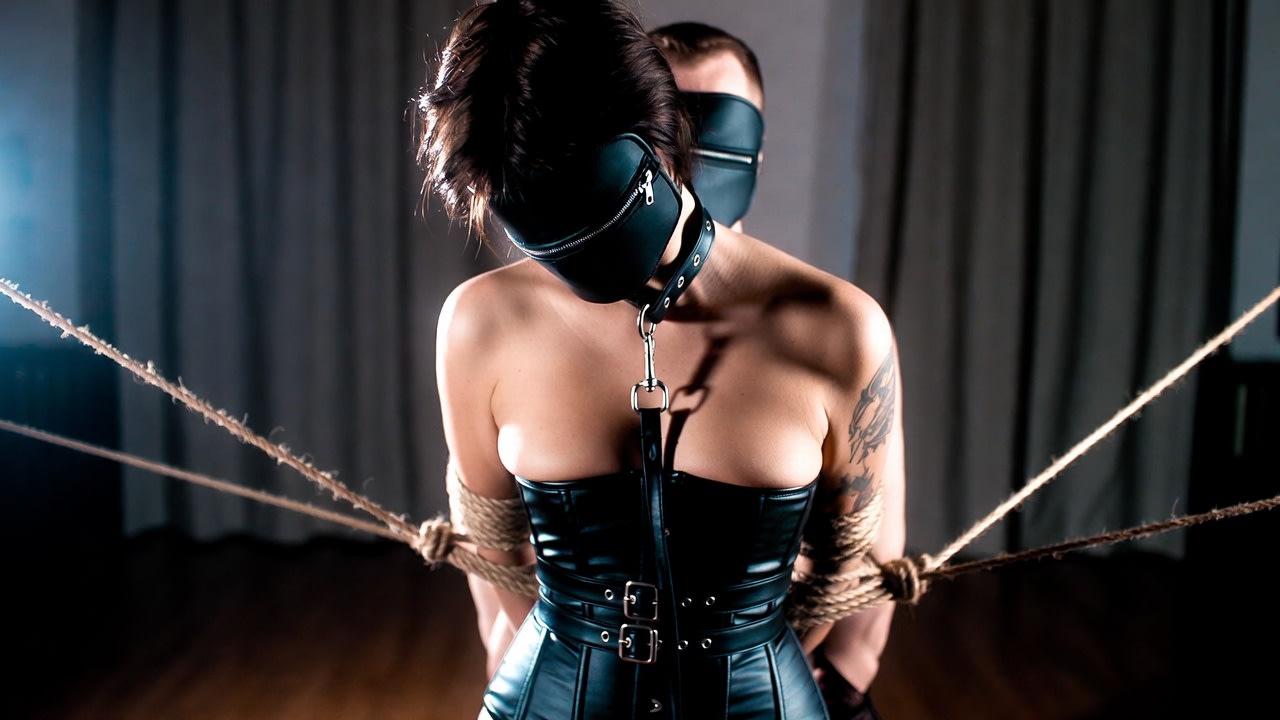
There is a moment, just before the rope draws tight, when everything in you goes quiet.
You feel the first turn of the line settle against your skin. Not yet pulling — only present. A weight. A promise. And in that breath before the tension comes, the noise you carry all day finally stops. The inbox. The performance. The endless small decisions. Gone. There is only the rope, and the hands that placed it, and the slow understanding that you are no longer in charge of holding yourself up.
This is where surrender begins. Not in the dramatic gesture, but in the stillness that comes before it.
The First Line
People imagine rope is about restriction. They picture being trapped, immobilised, made helpless. That is the surface of it, and the surface is not wrong — but it is not the heart, either.
The heart is tension. The deliberate, measured pull of a line drawn taut between two points, and you held in the middle of it. Rope does not simply bind you. It shapes you. It draws your spine into a posture you would never choose for yourself, lifts your chin, opens your chest, asks your body to yield by degrees until the yielding is the only thing left to do.
Good rope is conversation. The one tying reads your breath, your micro-flinches, the places you tense and the places you melt. Each wrap is a question. Each knot is a held answer. You learn very quickly that you cannot lie to rope — it knows where you are bracing, and it waits.
Tension Is the Teacher
Consider the line stretched to anchors on either side, and a body suspended in the pull of it. Not fully off the ground — that is a different art, for another evening — but held. Caught between forces. Unable to drift, unable to collapse, kept exactly where the rope decided you would be.
There is a particular surrender in being held in tension. You stop fighting the pull and you let it carry you. Your muscles, which have spent a lifetime gripping, finally hand the work to the line. And something strange happens: the more you give the rope, the lighter you feel. Resistance is heavy. Yielding is weightless.
This is the lesson rope teaches that words never quite manage. You cannot think your way into letting go. You have to feel the line take your weight and decide, in your body, to trust it. The mind follows the body here. It always has.
Why the Body Learns Faster Than the Mind
Ask someone to "relax" and watch them try harder. Relaxation is not a decision; it is a permission. Rope grants that permission by removing the option to do anything else. When your arms are bound and the line is holding your posture, there is nothing left to manage. The body, finally off duty, exhales — and the exhale is real, not performed.
This is why so many who carry control all day come here to put it down. The ones who decide, who manage, who hold everything together for everyone else. In rope, for once, the holding is done to them. They are allowed to be the one who is held.
The Blindfold and the Dark
Now take away sight.
The blindfold is not cruelty. It is generosity. It removes the one sense you rely on to stay vigilant, to anticipate, to manage the room. In the dark you cannot see the next touch coming. You cannot prepare your face. You cannot perform composure for an audience you can no longer see.
What rushes in to fill that absence is everything else. The drag of rope fibre across skin. The temperature of the air on bare shoulders. The sound of a single breath that is not yours, somewhere close behind you. The dark turns the volume up on the body until sensation becomes enormous, oceanic, impossible to ignore.
And anticipation — anticipation becomes its own form of touch. The waiting. The not-knowing. The exquisite suspense of a hand that might land in a second, or in a minute, and you have no way to tell which. Surrender deepens in the dark, because in the dark there is nothing to do but feel, and wait, and trust.
The Collar Says: You Are Held
And then there is the collar. The quiet anchor of the whole arrangement.
A collar is not jewellery, though it can be beautiful. It is a sentence made of leather. It says: you belong to this moment, and you have agreed to be kept in it. A line runs from the collar and the meaning runs with it — you are connected, leashed not to a wall but to a will. Someone is holding the other end. Someone is paying attention.
That is the secret no one tells you about being collared and bound and blind. It does not feel like abandonment. It feels like the opposite. To be this restrained is to be this attended. Every knot is proof that someone studied you closely enough to tie it. The collar is not the absence of care. It is care made into an object you can feel against your throat.
Trust Is the Knot That Holds Everything
None of this works without trust, and trust is not a mood. It is built.
It is built in the conversation before the rope ever comes out — the talk about limits, about the words that stop everything, about what is welcome and what is not. It is built in the attention paid to circulation and breath and the small sounds that mean more and the small sounds that mean enough. The one who ties holds a great deal of power, and the entire art rests on the fact that they hold it carefully.
Surrender is only beautiful when it is safe. A submissive who lets go inside good rope is not being reckless — she is being held by someone who has earned the right to hold her. That earning is the real erotic charge. Not the rope itself. The trust the rope makes visible.
This is why power exchange done well feels less like domination and more like devotion pointed in two directions. One person gives up control. The other person is made responsible for it. Both are surrendering something. Both are held.
The Quiet Negotiation Underneath
Watch a scene closely and you will see it is not one person acting on a passive other. It is a negotiation conducted in breath and pressure and the smallest shifts of weight. She tells him everything without a word — where it is too much, where it is exactly right, where she wants to be taken further. He listens with his hands. The rope is simply the language they have agreed to speak.
When the Rope Comes Off
Every line that goes on must come off, and the unbinding matters as much as the binding.
The rope loosens. The blood returns. The blindfold lifts and the room floods back in, too bright at first, edges soft and dreamlike. This is the descent, and a good one is handled with the same care as everything that came before — warmth, water, a steady presence, no rush to make you a functioning adult again before you are ready.
Because something happened in there. You went somewhere. The deep quiet of full surrender is not nothing; it leaves a residue, a softness, a strange clarity. Many describe it as the most rested they have felt in months — as though being completely held allowed them to finally, fully, set everything down.
That is the gift hiding inside all of it. The corset, the collar, the blindfold, the line drawn taut. They are not about taking your freedom. They are about giving you, for one held hour, permission to stop carrying yourself.
The Surrender Is the Point
So let the rope be a teacher. Let the tension hold you up when you are tired of holding yourself. Let the dark turn off the part of you that performs. Let the collar remind you that being kept is not the same as being lost.
Surrender is not weakness. It is one of the bravest things a person can do — to hand over control, deliberately, to someone who has proven they will keep you. To let yourself be drawn taut and held in the line, and to discover that the holding is the most cared-for you have ever felt.
The rope knows where you brace. It waits for you to let go.
When you finally do, you will understand what every bound and blindfolded soul before you understood: that the deepest surrender is not a loss at all. It is a homecoming.
SubSurrender is an adults-only space for the curious and the committed. Explore consciously. Negotiate everything. Surrender only into hands that have earned it.