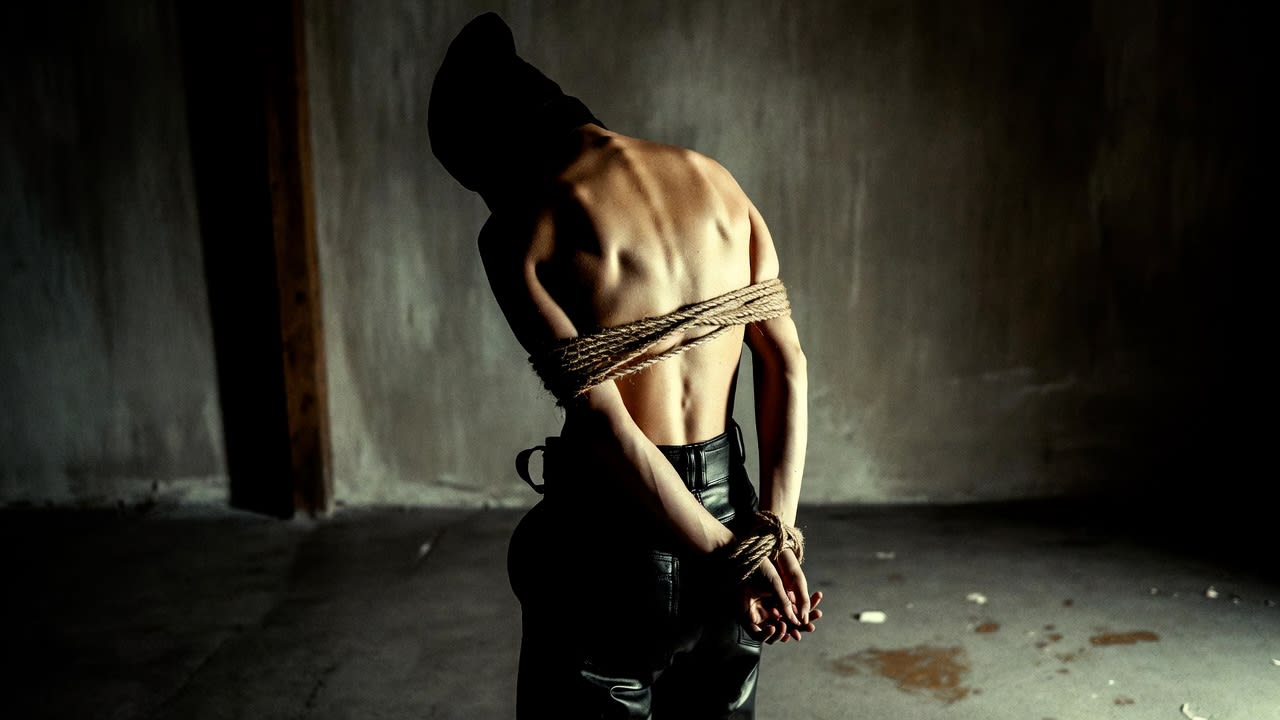
Look at your hands.
You use them for everything. You reach with them, hold with them, fix with them, defend with them. They are the part of you that acts on the world — the tools of your competence, the proof that you are managing, coping, in control. When something falls, your hands catch it. When something threatens, your hands rise. Your whole life of doing runs through those ten fingers.
Now imagine them taken away.
Not harmed. Not hurt. Simply removed from service — folded behind your back, wrapped in rope, wrist crossed over wrist, until reaching is no longer something you do. The rope winds around your chest, snugs against your arms, and settles. It does not squeeze. It does not need to. It only has to be there, patient and certain, saying one thing over and over in its quiet fibrous voice: not yours right now.
This is where surrender stops being an idea and becomes a fact of the body. This is the bound standing tie — one of the oldest, simplest, most devastating gestures in rope. And it is what I want to talk about today: what it actually means, beneath the aesthetics, to give up your grip.
The Hands Are Where Control Lives
People think control lives in the mind. It does not. It lives in the hands.
Watch someone anxious: their hands are busy. Checking a phone, straightening a sleeve, gripping a cup that does not need gripping. The hands are always negotiating with the world, always ready to intervene. Even in stillness, they hover near readiness. This is why simply telling someone to relax achieves nothing. The mind can agree while the hands stay on duty.
Rope understands what words do not. When the wrists are bound behind the back, the negotiation ends. There is nothing to check, nothing to adjust, nothing to catch. The hands are off duty — formally, physically, unarguably. And something remarkable follows: the rest of the body, deprived of its first responders, begins to stand down too. The shoulders admit their weight. The breath drops from the chest into the belly. The head, with nothing left to supervise, bows or tilts back on its own.
I have watched this transformation more times than I can count, and it never loses its beauty. It rarely takes more than a few minutes. The rope does in moments what a week of rest cannot, because the rope does not ask the body to relax. It makes vigilance impossible — and the body, finally excused, lets go.
Behind the Back Is Different
Wrists bound in front is one thing. You can still see your hands, still hold them near your center, still keep them — symbolically — in the conversation.
Behind the back is another matter entirely.
You cannot see what holds you
Bound behind you, your hands leave your field of vision. You feel the rope but you cannot watch it. You know the knot exists but you cannot inspect it. Whatever your hands are doing back there — resting, curling, slowly opening — happens outside your witness. You are asked to trust a thing you cannot verify. For the analytical mind, the mind that audits everything, this is the real restraint. The rope holds the wrists; the placement holds the mind.
The chest opens whether you like it or not
Pull the arms back and the body's architecture changes. The chest lifts and opens. The posture that armors us — shoulders curled forward, heart tucked safely behind them — becomes unavailable. You stand more exposed not because you chose openness, but because closing is no longer offered. There is an honesty in that geometry. The body is arranged into candor.
Balance becomes a shared project
Without arms to counterweight and correct, standing itself grows delicate. You sway a little. You find your feet paying attention. And you become aware, keenly, of the other presence in the room — the one who tied you, who watches, who would steady you. Your balance is no longer entirely your own concern. It has become a shared responsibility. That, more than any knot, is the essence of power exchange: my stability is partly in your keeping now.
The Room Matters: Why Bare Walls Serve Surrender
Picture the scene: a stripped room, concrete walls, one column of honest daylight. No velvet, no candles, no set dressing. Just rope, skin, and quiet.
This bareness is not poverty. It is precision. A cluttered room offers the mind a thousand exits — things to look at, catalogue, narrate. An empty one offers nothing but the experience itself. The concrete does not perform for you. The light does not flatter you. Every sensation that remains is real: the wrap of rope across the chest, the cool air on an exposed back, the sound of your own breathing returning to you off hard walls.
Minimalism and submission are old friends. Both are the practice of removing what is unnecessary until what remains is true. When I strip a room, I am doing to the space exactly what the rope does to the will — clearing it, quieting it, reducing it to essentials. What is left, in both cases, is presence.
What the Rope Does Not Take
Let us be precise, because precision is a form of respect.
The rope takes your grip. It does not take your voice. A bound body that cannot speak its limits is not in surrender; it is in danger. Real rope, done well, rests on a foundation laid long before the first wrap: the negotiation, the shared vocabulary, the agreed signals, the absolute knowledge that one word ends everything. The restraint is physical; the consent is never restrained. This is what outsiders reliably misread. They see the rope and think it overpowers. Those inside know the truth — nothing in that room is stronger than the word that unties it all.
The rope does not take your dignity either. Look again at that figure standing bound in the bare room. There is nothing crumpled about it. The spine is long. The stance is planted. This is not a person diminished; it is a person concentrated — all the scattered energy of doing gathered into the single, luminous task of being held. Surrender of this kind is not collapse. It is an offering, made standing up.
Why Giving Up Your Grip Feels Like Rest
Here is the paradox that brings people to rope and keeps them there for decades: the moment of least control is, for many, the moment of greatest peace.
It should not surprise us. Carrying yourself is work. Being the one who catches, fixes, manages, holds — it is a weight so constant you stop noticing it, the way you stop noticing a sound that never ends. The rope ends the sound. For an hour, the catching is someone else's task. The vigilance is someone else's task. Your only assignment is to breathe, to feel the fibers hold you, and to let them.
People expect bondage to feel like capture. What it more often feels like — when there is trust, when it is done with skill and intent — is being kept. There is a reason the same hands that tie the rope also untie it, slowly, at the end; a reason the wrists are held and rubbed warm as the wraps come off; a reason the first thing returned to you, before your hands, is a voice telling you that you did beautifully. The rope was never the point. The keeping was.
Begin Where You Are
You do not need a concrete room or a coil of hemp to begin. You need only to notice your hands — how much they hold, how rarely they rest — and to ask yourself what it might mean to let someone trustworthy take that holding from you for a while.
Start with stillness. Start with hands folded behind your back, unbound, held there by nothing but your own decision, and feel how quickly the mind objects. That objection is the edge of something. Rope simply makes the decision durable — lends you its certainty until you have grown your own.
The grip you are so afraid to lose was never keeping you safe. It was only keeping you busy.
Put your hands behind your back. Breathe. Begin.
— Mistress Krigar