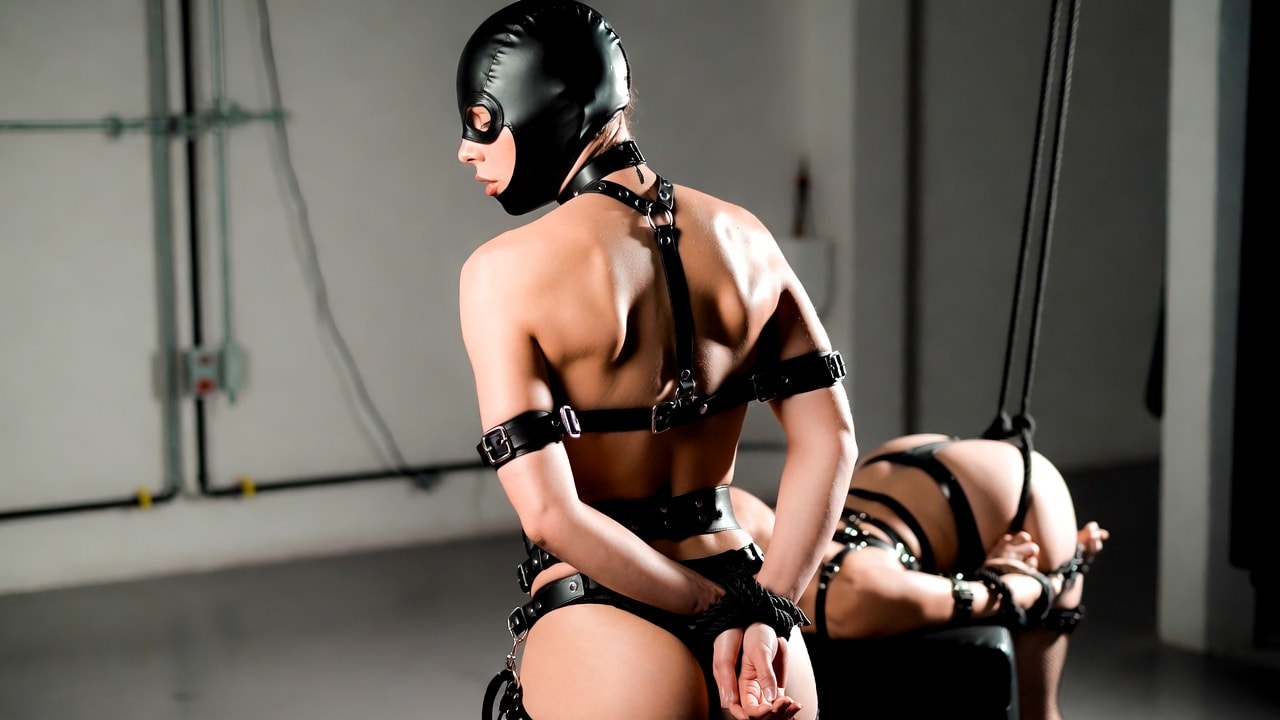
There is a particular quiet that arrives the moment your hands are taken from you. Not the noise of a struggle. The opposite. A stillness that settles over the whole body once the buckles are drawn tight and the arms are folded away behind the spine, out of reach, out of use. You stop reaching. You stop reaching, and something in you finally lets go.
This is what the leather arm harness is for. Not decoration. Not spectacle. It is a slow, deliberate way of saying: you will not need your hands here. I have them now.
What the Harness Actually Does
Look at the construction of it. Cuffs at the wrist. A strap that draws the forearms together. Bands at the upper arms, buckled above the biceps, pinning the elbows in toward one another. A line up the back that keeps the shoulders open and the chest lifted. Every strap has a job, and every job removes one small freedom you did not know you were holding onto.
The wrists go first. That is the freedom you expect to lose. But it is the arms above the elbow — the part most people never think about — that changes the posture entirely. Once those are bound, you cannot round your shoulders. You cannot fold inward and hide. The harness holds you open whether you feel brave or not. It decides your posture for you, and there is a strange relief in that. You are not asked to hold yourself upright out of willpower. The leather does it. You only have to allow it.
The Bared Spine
With the arms drawn back, the spine comes forward. The long line of the back is exposed — shoulder blades, the groove down the centre, the small of the waist. It is one of the most vulnerable presentations there is, and one of the most honest. You cannot see what is behind you. You cannot cover the skin that is bared. You simply stand and let the room have the sight of you.
Vulnerability is often talked about as a weakness to be protected. In this room it is the whole point. The bared spine is not a failure of guarding. It is guarding, set down on purpose, handed over.
The Discipline of Standing Still
Kneeling gets most of the attention. The floor, the bow, the lowered head — those are the images people reach for when they imagine submission. But standing is harder. Standing bound is its own discipline, and a demanding one.
On your knees, the floor holds part of your weight and the position gives you somewhere to go. Upright, there is nowhere. You hold the line of your own body, arms useless behind you, and you wait. No task in your hands. No motion to busy yourself with. Just the quiet, upright fact of being present and being seen.
This is where the mind gets loud, at first. The hands that cannot move want to fidget. The thoughts that have nothing to do reach for something to solve. And then — if you let them — they quiet too. There is nothing to fix. There is nothing to reach for. There is only the standing, and the waiting, and the slow understanding that being still is enough. That you are enough, exactly as you are placed.
Made to Wait
Notice that you are not always the centre of the room. Sometimes another is being attended to first — laid out, worked over, cared for — while you stand at the edge of the light and hold your position. This is not neglect. It is trust. I do not need to watch your hands because your hands are mine. I do not need to keep you in motion because I know you will keep still.
Being made to wait is a gift dressed as patience. It tells you that you are secure enough in your place that you do not need constant reassurance. You can be set down, like something valuable, and left exactly where you were put, and you will be there when I return to you. That knowledge does more for the nervous system than any amount of attention could.
The Cold Room
The setting matters. Bare concrete. Grey light. Nothing soft to lean into, nothing warm to distract. A room stripped of comfort is a room stripped of excuses. There is no cosy blur to hide inside. Only clean lines, cool air on bared skin, and the sharp clarity of knowing exactly where you are and why.
People assume the cold is cruelty. It is not. It is honesty. The chill on the skin keeps you here, in the body, in the moment, unable to drift. It is the same reason the room is quiet and the harness is plain black leather with no ornament. Nothing here is trying to seduce you into forgetting yourself. Everything is asking you to remember: you chose this stillness, you walked into this room, you offered your hands.
Surrender Is Not the Same as Helplessness
This is the part that matters most, and the part most easily misread from the outside. Bound arms look like helplessness. They are not. Helplessness is having no choice. What happens in this room is the opposite — it is choice, exercised fully, then set down.
You consented to every buckle. You could name the word that ends it in a single breath. The harness does not overpower you; it holds an agreement you already made. That is the difference between restraint and force, between surrender and loss. Surrender is something you do, actively, on purpose. It is one of the most self-possessed acts a person can perform: to be entirely capable, and to choose stillness anyway.
That is why the bound submissive so often looks calm rather than frightened. There is nothing to defend. The decisions are made. The hands are given. All that is left is to breathe, and stand, and belong to the moment.
Coming Back
Eventually the buckles are loosened, in reverse order — the upper arms, the forearms, the wrists last. The blood returns. The shoulders come down. The hands, which spent so long as no one's concern, are yours again, and they feel almost unfamiliar for a moment, like something returned from a long trip.
What stays afterward is not the memory of the leather. It is the memory of the quiet. The way the mind went still when there was nothing to reach for. The way being held open, exposed, and made to wait turned out to feel less like exposure and more like safety. That is the thing worth keeping. The harness comes off. The stillness, once you have found it, is yours to return to.
Stand as you were placed. Let your hands be mine for a while. You will find, as so many before you have found, that the moment you stop reaching is the moment you finally arrive.
— Mistress Krigar