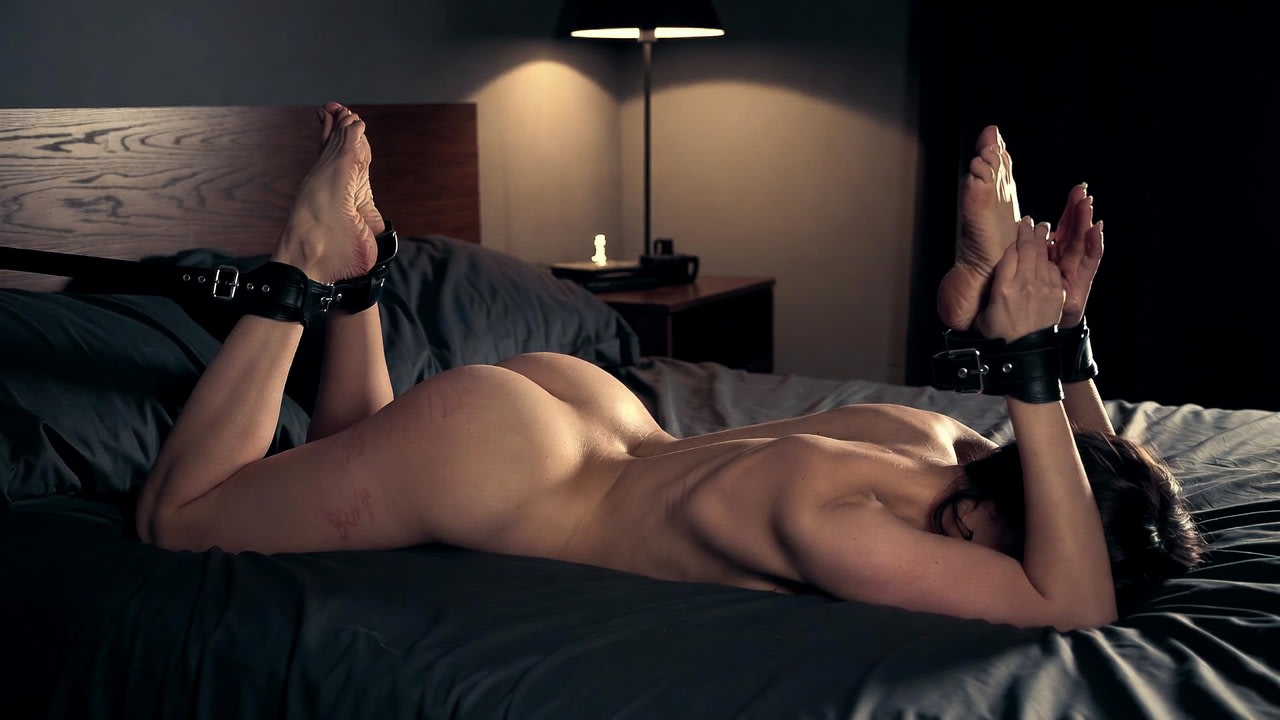
There is a particular kind of quiet that only arrives when there is nothing left for you to do. Not because you are idle. Because you have been made still. Both wrists held. Both ankles held. The body laid out across the sheets like an offering, and a single lamp burning low in the corner, keeping watch.
This is not the loud kink. There is no spectacle here. There is leather at every limb, a warm room, and the long exhale of someone who has finally stopped holding their own weight. I want to talk about that. About what happens when surrender stops being a gesture and becomes the whole shape of your evening.
Why Four Points Changes Everything
A single cuff is a suggestion. Hands behind the back, a wrist caught and held — that is a conversation. You can still turn. You can still curl in on yourself, protect the soft front of you, decide how much to give.
Four cuffs end the negotiation. Wrists drawn one way, ankles drawn the other, and suddenly the body has no folding left in it. You are open. Laid out. The line of you on the bed is the line someone else has decided, and you have agreed to.
People assume this is about helplessness. It is not. It is about completeness. When every limb is accounted for, the part of you that spends all day bracing — managing, planning, holding the next thing and the thing after that — has nothing to grip. It lets go because there is nothing else to do. That is the gift hidden inside the restraint. Not the loss of control. The permission to stop carrying it.
The Leather Knows Its Job
Look closely at a good cuff and you will see it was never meant to hurt. Wide leather, soft on the inside, a buckle that holds without biting. It is built to be felt and trusted, not endured. The weight of it sits on the wrist like a hand that does not move. A reminder, all evening, without a single word spoken.
That is the quiet genius of being bound in leather rather than rope or steel. Leather warms to you. It takes the heat of your skin and gives it back. Within minutes the cuff is no longer cold, no longer foreign. It is part of you, or you are part of it, and the boundary between held and holding goes soft.
And the buckle — the buckle matters more than people think. The sound of it closing is the sound of a decision being made for you. One click at the wrist. Another at the ankle. Each one a small door shutting, and on the other side of all four doors, a stillness you could not have reached on your own.
One Lamp in a Dark Room
Notice the light. Not the overhead glare of a clinic. Not the theatrical red of a dungeon. One lamp, low and warm, throwing a single pool of gold across the dark.
This matters. A bound body in harsh light is on display. A bound body in one soft lamp is being looked at by someone who chose the lamp on purpose. The darkness around the edges is not empty. It is intimate. It says: the rest of the world is switched off now. There is this bed, this light, and the two of you inside it.
Surrender needs a room that holds it. The lamp is not decoration. It is part of the rope, in its own way — a boundary drawn in light around the place where you are allowed to let go.
The Stillness After the Last Buckle
There is a moment, once the fourth cuff is closed, when everything goes quiet at once. The adjusting stops. The testing of the restraints stops. You pull, gently, the way everyone does, just to feel the limit — and the limit is there, kind and immovable, and so you stop pulling.
That is the threshold. On one side of it you are a person managing a situation. On the other side you are simply present, breathing, held. Most people cross it without noticing the exact step. They only know that the room has gone soft and their thoughts have gone quiet and the weight they did not know they were carrying has been set down somewhere they cannot reach it.
What the Body Gives Up, and What It Gets Back
Submission of this kind is a trade, and an honest one. You give up your reach. Your ability to fix, to adjust, to leave. In return you are given something most of us are starved for: the experience of being completely tended to while doing nothing to earn it.
You do not have to perform. You do not have to be impressive. Bound and laid out, you are valuable simply because you are there and you agreed to be. The mind that constantly tallies your worth against your output finds, for once, that the ledger is closed. There is nothing to add up. There is only the warmth of the lamp and the warmth of the leather and the slow certainty that you are being watched over.
That is the deilig part — the indulgence at the centre of it. Not pain. Not even sensation, necessarily. The luxury of being held so completely that you are finally, properly, off duty.
Trust Is the Thing Doing the Binding
I will be plain, because it deserves plainness. The cuffs do not bind you. Trust does.
Leather and buckles are easy. Anyone can fasten a strap. What is not easy — what is, in fact, the whole point — is lying still and open and unable to reach, while believing all the way down that the person who put you there will not betray the position they have placed you in. The restraint is just the visible shape of an invisible thing. You are trusting someone with your stillness. That is an enormous gift, and a wise dominant knows it, and treats it like one.
This is why surrender like this is never weakness. It takes more strength to be bound and unbraced than to stay armoured and in control. The submissive in the warm dark is not the smaller person in the room. Often they are the braver one.
How to Hold Someone Who Has Given You This
For the one holding the keys, a few quiet truths. Negotiate before the first buckle, never after. Know your safeword and your nonverbal signals and check that the body in front of you can use them — a hand to squeeze, a sound to make, an object to drop. Keep the circulation honest; a cuff should hold the will, not the blood. Stay in the room, in every sense. And when the cuffs come off, do not vanish. The unbuckling is not the end of the scene. The warmth afterward — the blanket, the water, the hand on the back of the neck — is where the surrender is made safe to have given.
Aftercare is not an afterthought. It is the second half of the promise. You took someone apart on purpose. You stay until they are gathered back together.
The Quiet You Carry Out of the Room
Here is what surprises people most. The stillness does not stay behind in the bedroom. Something of it follows you out.
The next morning the world is the same demanding place it always was, but the part of you that learned, last night, that it was allowed to put everything down — that part remembers. You walk a little looser. You grip a little less. You have proof, written in leather and warm light, that there is a place where you do not have to hold yourself up, and that you can return to it.
That is the real work hiding inside the pleasure. Surrender practised on purpose teaches the nervous system a thing it rarely believes otherwise: that it is safe, sometimes, to stop. Four cuffs and one lamp can say that more convincingly than a year of telling yourself to relax.
So let yourself be laid out. Let the buckles close, one by one, each a small door between you and the noise. Let the lamp keep its watch. There is nothing for you to do here. That is precisely the point.
Be still. Be held. That is all I ask.
— Mistress Krigar