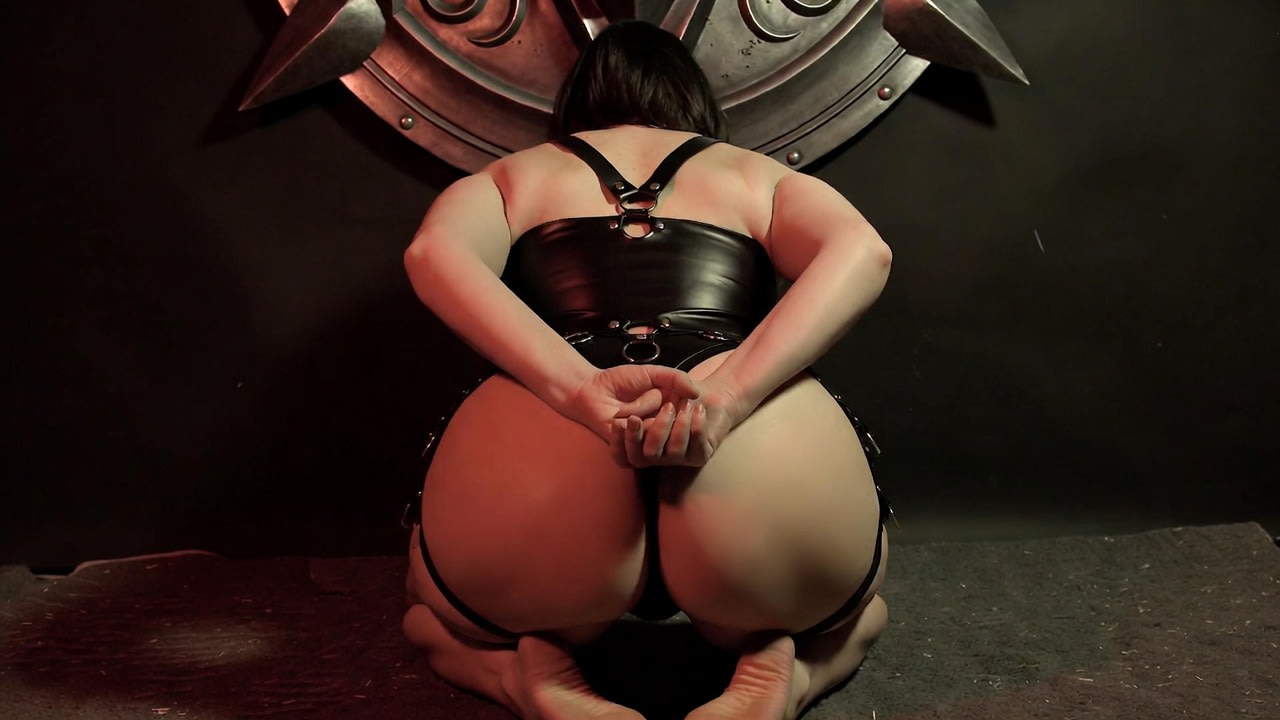
There is a version of kneeling everyone pictures: face upturned, eyes seeking, the whole body angled toward the one who commands it. Asking, always asking. This is not that.
In this room, the kneeler faces the wall. Faces the shield — the great steel emblem hung where an altar would be, catching the red light like something forged rather than lit. Hands are clasped at the small of the back, fingers laced, knees folded on rough stone. The door is behind. The room is behind. Everything that could happen next is behind.
And still, the body does not turn.
The Loudest Thing in the Room Is a Back
We underestimate the back. We think expression lives in the face — the bitten lip, the lowered lashes. But a Mistress reads shoulders the way sailors read weather. A back held in stillness, hands surrendered into their own clasp, says more than any rehearsed word. It says: I am not monitoring you. I am not managing this. I have stopped negotiating with the moment.
To kneel facing someone is, in its way, still a conversation. You watch their face for the next instruction; you perform your obedience toward an audience. Turn the body around and the conversation ends. What remains is the purer thing underneath it: the state itself. Obedience with no one to perform it for is no longer performance. It is condition.
Hands Behind the Back: A Lock With No Metal
Look at the hands. No cuffs. No rope. Nothing holds those wrists together except a decision, renewed second by second, to keep them there. This is what I call the soft lock — restraint made entirely of intention. Steel restrains the body. The clasp restrains something more interesting: the impulse to check, to fix, to adjust, to reach for control the way a hand reaches for a railing.
Anyone can stay still in bondage. Staying still in freedom is the discipline. The clasped hand is the kneeler saying: you could have bound me, and I have saved you the trouble.
Why the Shield
Every practice needs a fixed point. Monks have their icons; soldiers their standards. The shield on the wall is not decoration — it is the emblem of the one who is served, present even when she is not. Kneeling before it is kneeling before the idea of her: her order, her standards, the shape of the discipline itself.
This matters more than it first appears. Submission that only exists when the dominant is watching is weather — it comes and goes with the conditions. Submission that holds before an empty room, before a symbol, in the red half-dark with no witness but the wall, is climate. It is who you have decided to be.
The Emblem Does Not Blink
There is a comfort in facing something that cannot look away and cannot be disappointed prematurely. The shield does not react. It does not soften when you tremble or hurry you when you settle. Before it, the kneeler is granted the rarest audience of all: one with no feedback. Whatever rises in you — restlessness, want, the itch of pride — rises and passes with no one to see it but you. That is where the real work happens. Not in the scene. In the waiting for the scene.
Your Back to the Door: Trust, Rendered in Posture
Now the harder truth of this position. The door is behind you. Footsteps, when they come, will come from a direction you cannot see. Every animal instinct you own objects to this arrangement. The body wants walls behind it and exits in view; a thousand generations of survival insist on it.
Which is precisely why the posture means something.
Turning your back is the body's way of saying what the mouth says too easily: I trust you. Words cost nothing. Vertebrae tell the truth. When she enters — and you hear her before anything else, the latch, the unhurried heel on stone — you will not turn. You will feel your own pulse argue with you. You will keep your eyes on the steel. And she will see, from the doorway, exactly what she asked for: not a face arranged into obedience, but a spine that has stopped bracing.
That first sight of you — settled, unwatching, already hers — is a gift you can only give from this angle.
The Discipline of Not Turning Around
Let me be practical, because stillness is a practice, not a mood.
The first minute kneels easily. The body is pleased with itself. By the fifth, the knees file their complaints; by the tenth, the mind begins its bargaining — surely she meant a shorter wait; surely a glance over the shoulder costs nothing. This is the true opponent, and it does not live in the knees. It lives in the part of you that has never once let a moment simply arrive without inspecting it first.
The practiced kneeler learns to greet each wave rather than fight it. Breathe down into the belly. Let the weight sink through the fold of the legs into the floor. Return the eyes to one rivet on the steel and let it hold you the way an anchor holds a hull — not rigidly, but surely, with room to sway. The stillness that survives the tenth minute is not the same substance as the stillness of the first. One is posture. The other is surrender.
What She Sees That You Cannot
Here is the quiet symmetry of the arrangement: you have given up the view, and in exchange you have become it. The curve of held shoulders, the laced fingers, the soles upturned and bare — the whole composition facing away, asking nothing. A kneeler facing the wall is not hiding from her gaze. He is resting in it, the way you can only rest in something you have stopped trying to meet.
You will never see yourself in this posture. She will never see you more clearly.
Bringing the Wall Home
Not everyone has stone floors and steel emblems, and not everyone needs them. The practice translates. A corner of a room. A mark on the wall at eye level. Five unwitnessed minutes with hands clasped and the door behind you, held not for anyone's approval but because you said you would. Dynamics conducted across distance lean on exactly this: the ritual that holds its shape when no one is watching is the only kind that was ever real.
Start small. Two minutes, then five. Let the position teach you at its own pace. The point was never endurance for its own sake — pain is not the curriculum here, and this posture should be adjusted until it is sustainable. The point is the moment the waiting stops being something you are doing and becomes somewhere you are.
The Red Light Does Not Hurry
In the end, the image explains itself. A figure in black leather, folded small before something vast and unmoved, in light the color of banked coals. Nothing in the frame is urgent. Nothing is asked. The shield keeps its counsel, the hands keep their clasp, and somewhere behind — unseen, unhurried, entirely certain of what she will find — she is coming.
Kneel facing the wall. Give up the door. What you are guarding was never yours to guard anyway.
— Mistress Krigar