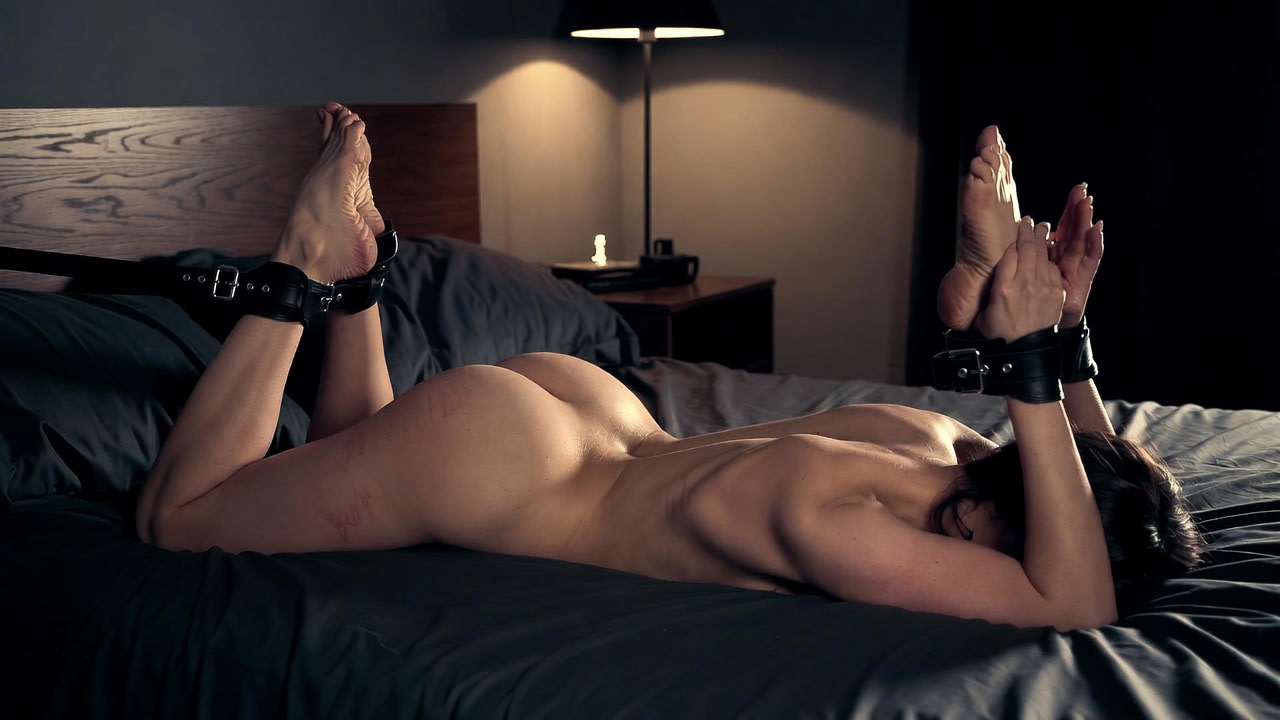
There is a photograph of a moment I want you to sit with. A bedroom, not a dungeon. A lamp turned low, the light warm as skin. A woman lies face down on the bed, and her ankles and wrists have been buckled together behind her in dark leather. She is not going anywhere. That is the entire point — and it is not the point you think.
Most people look at a hogtie and see restriction. They count what has been taken away: the hands, the feet, the option of standing, the option of leaving. They see a body made helpless and assume the story is about helplessness.
They are reading it backwards.
The hogtie is not about what is taken. It is about what is finally, mercifully given: permission to stop. Not encouragement to stop. Not an invitation to relax that your restless mind can decline. Permission with hardware on it. Stillness you cannot argue with.
The Shape the Body Makes
Look at the position honestly. Face down. Chest to the mattress. The spine settles long and low while the ankles rise, drawn back to meet the wrists. The body folds into a shape it would never choose on its own — a bow, gently strung, resting on its own centre.
Every other position leaves you options. Kneeling, you can rise. Standing bound to a wall, you can shift your weight, negotiate with gravity. Even spread and tied to the four corners of a bed, you can lift your head and watch.
The hogtie removes the last of it. You cannot watch. You cannot brace. You cannot present yourself at a better angle or check whether you are being admired. The face turns to the sheets and the world reduces to what you can hear, what you can feel, and what you have agreed to trust.
That is why it belongs to the deep end of surrender — not because it is severe, but because it is complete.
Why Stillness Is Harder Than Almost Anything
Here is a truth I have learned from years of watching people give themselves over: stillness is the discipline almost no one arrives with.
Impact can be endured with adrenaline. Commands can be followed with eagerness. But stillness — true stillness, the kind where nothing is asked of you at all — strips a submissive of every tool they normally use to feel worthy. There is no task to complete well. No order to obey promptly. No performance to be graded.
The Instinct to Perform
So many of you confuse submission with productivity. You want to be useful. You want to be good at it. You kneel beautifully, you answer promptly, you arch on cue — and underneath all of it runs the same anxious engine that runs your working life: am I doing enough?
The hogtie switches that engine off at the wall. Bound like this, you cannot do anything. Which means, for once, you cannot do anything wrong. The leather makes excellence impossible, and in doing so it makes failure impossible too. What remains, when performance is off the table, is simply being. Being there. Being held. Being enough without a single accomplishment to show for it.
For some, that is the most confronting thing I can offer. For most, once the trembling settles, it is the closest thing to rest they have felt in years.
The Bed, Not the Dungeon
Notice where this scene happens. Not on concrete. Not against brick or chain. On a bed, with soft sheets and a lamp glowing on the nightstand — the most domestic furniture there is.
This is deliberate, and it changes the meaning of everything.
A dungeon says: you have entered my world. A bed says: my world was already inside yours. The place where you sleep, the place where you are most unguarded every night of your life, becomes the place where surrender is practised. The warmth of the lamp is not set dressing. It is a promise. Nothing that happens in this light needs to be survived. It only needs to be received.
There is a particular sweetness — the Norwegians would say deilig, and no English word carries it properly — in being strictly bound in a gentle place. The strictness and the softness do not cancel each other. They complete each other. The cuffs hold hard so the rest of you can go soft.
Leather Speaks a Slower Language Than Rope
Rope is conversation — wraps and knots, tension laid on turn by turn. Leather is a verdict. A cuff does not build gradually. It closes. The buckle finds its notch with a click, and the decision is made.
Wide leather cuffs at the wrists and ankles carry their own message: you are going to be here a while, and you are going to be comfortable about it. They spread the hold across the skin instead of biting into it. They are the difference between being grabbed and being kept.
And the strap that joins wrists to ankles — that short, decisive bridge — is where the poetry lives. It means your own body has become the restraint. You are not tied to the bed. You are tied to yourself. The tension you carry everywhere, the tension you call normal, has been made literal, buckled closed, and handed over to someone else to supervise.
What She Is Doing While You Do Nothing
You may think a hogtie is a position in which you are left. You are wrong. It is a position in which you are watched.
While you lie there, face down, learning to breathe in a new shape, your dominant is working — quietly, invisibly. She is reading the colour of your hands. She is listening to the rhythm of your breath, the little catches and the long releases. She is noting when the wriggling stops and the melting starts, because that transition is the entire harvest of the scene, and she does not intend to miss it.
Enforced stillness is never neglect. Done properly, it is the most attention you will ever receive while apparently being ignored. You do nothing; she does everything. That is the trade, and it is a generous one in both directions.
Safety Is the Frame Around the Picture
I will say this plainly, because the beauty of this position depends on it being done well.
The hogtie is an advanced tie. Face-down positions with the chest loaded and the limbs drawn back put real demands on breathing, circulation and nerves. So the rules are not decorative. Negotiate before anything is buckled. Agree on a safeword — and for a position where speech can tire, agree on a non-verbal signal too. Keep the strap between wrists and ankles forgiving at first; depth can always be added, but strain cannot be taken back. Check hands and feet often for warmth and colour. Keep safety shears or quick-release buckles within reach. And never — never — leave a hogtied person alone, not for a minute, not to fetch anything. The stillness only works because someone is awake inside it on your behalf.
None of this diminishes the mood. Care is the mood. A submissive who knows the frame is solid can lean their whole weight against the picture.
Coming Back
The unbuckling deserves as much ceremony as the binding. One strap at a time, slowly, with hands that linger. The ankles come down like something being lowered on a rope, not dropped. The wrists are rubbed, the shoulders rolled, the body unfolded back into the world it left.
Expect quiet. A person who has been truly still often surfaces the way a sleeper surfaces — reluctant, blinking, half in love with the place they have just been. Blankets. Water. A hand resting on the back of the neck, unhurried. Let the return take the time it takes.
And then notice what they look like. That loose, unguarded, faintly astonished expression — that is what a nervous system looks like when it has been allowed, for one warm hour, to stop defending itself.
The Invitation
You spend your whole life holding yourself together. Upright, capable, self-steering, always braced for the next demand. The hogtie is the one arrangement in which holding yourself together is not your job. The leather holds. She watches. You breathe.
Face down, held still, in lamplight.
Not helpless. Held. Learn the difference, and you will understand why some of us call this position the quietest room in the house.
— Mistress Krigar