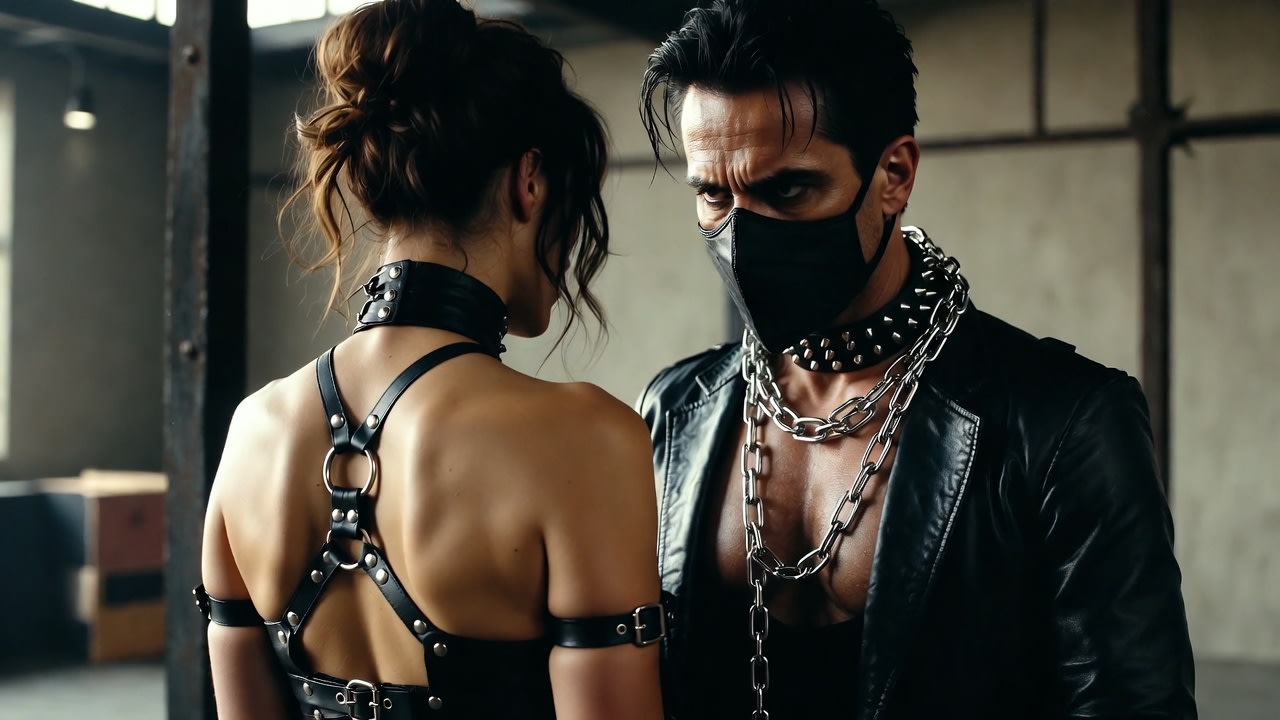
The room is almost empty. Concrete, steel, a bare window. Two people stand facing each other, and nothing has happened yet. No command has been given. No lead has been clipped. There is only the look — steady, unhurried, entirely on you.
Most people think a scene begins with the first order. It does not. It begins here, in the stillness before it, when your dominant looks at you and does not look away. This is the moment this piece is about: the weight of being seen, and why it may be the most demanding — and most rewarding — part of power exchange.
Before the First Command, There Is the Look
Every dynamic worth having starts with attention. Not touch. Not rope. Not the collar. Attention.
When you stand before someone who holds authority over you — freely given, carefully negotiated — the first thing they take is not your movement or your words. It is your anonymity. In ordinary life you move through the world half-seen. People glance at you, categorize you, move on. A dominant does the opposite. They stop. They look. They take their time.
That is why the moment in the doorway, or in the middle of a bare room, can feel heavier than anything that follows. The gaze is the first act of dominance and submission. Everything after it is elaboration.
Why Being Seen Is Harder Than Being Bound
Restraint is simple. The body is held, and the body understands being held. Being seen is not simple.
The instinct to hide
You have spent your whole life managing how you are perceived. Adjusting your posture. Softening your opinions. Choosing the angle. This is normal; it is also exhausting. Submission asks you to set that management down. To stand in a harness of your own choosing, back straight, and let someone look at what is actually there — the nerves, the want, the pride, the uncertainty.
That is exposure of a deeper kind than skin. Many submissives will tell you the same thing: the blindfold is easy. The eye contact is hard.
What the gaze asks of you
It asks for honesty. Not performance, not the version of yourself you think will please — honesty. A good dominant can tell the difference at a glance, and the difference matters. Performed surrender is decoration. Honest surrender is the whole point.
So when the look lands on you and your instinct is to drop your eyes, to fidget, to fill the silence — notice that instinct. It is telling you exactly where your edge is. The edge is not the impact or the rope. The edge is being known.
The Inspection: A Ritual of Attention
In many D/s dynamics this moment is formalized. The submissive presents. The dominant inspects. Buckles are checked, posture is corrected, the collar is settled at the throat with two fingers and a pause.
From the outside this can look like theatre. It is not theatre. It is a ritual of attention, and rituals do real work.
The inspection tells the submissive: I see all of it. I am not in a hurry. Nothing about you is being overlooked. The care in it is the message. When someone examines the fit of a strap at your shoulder as if it were the most important task in the world, what they are actually saying is that you, right now, are the most important task in the world.
Very few experiences in adult life offer that. It is one reason people come to this lifestyle and stay: not for intensity, but for the quality of the attention. Intensity fades by morning. Being thoroughly seen does not.
What the Dominant Carries in That Moment
It would be a mistake to think the weight in this moment rests only on the one being looked at.
To look at someone that way — openly, deliberately, with intent — is to accept responsibility. The dominant standing in that bare room is not admiring a possession. They are reading a person. Breath, shoulders, the small tremor of anticipation, the flicker that says eager and the different flicker that says uncertain. They are updating everything they know before a single word is spoken.
This is what authority actually looks like in a healthy power exchange. Not volume. Not theatrics. Observation, patience, and the discipline to act only on what is really there. A dominant who cannot hold this moment quietly — who rushes past it to get to the interesting parts — has misunderstood the assignment. The look is the interesting part. It is where consent lives and breathes between the formal negotiations: a continuous, wordless check-in.
Chains and leather set the stage. The eyes run the scene.
Trust Is Built at Eye Level
People outside the lifestyle often assume trust in kink is proven in extremity — that the deeper the scene, the deeper the trust. In practice, trust is built in smaller currency, and most of it changes hands through the eyes.
Meeting your dominant's gaze and holding it, even while your pulse argues with you, is a deposit. Letting them watch you struggle with the stillness instead of covering it with a joke is a deposit. On the other side: noticing, adjusting, never using what is seen carelessly — those are the dominant's deposits. Over weeks and months these small exchanges compound into something with real weight. That is the treasury a serious dynamic draws on when it goes deeper.
This is also why the moment before the scene is a better measure of a dominant than anything that happens during it. Watch how someone looks at you when nothing is happening yet. Are they present? Are they patient? Do you feel gathered up by their attention, or merely appraised? Your body will answer honestly. Listen to it.
How to Practice Being Seen
Like everything else in this lifestyle, being seen is a skill. It improves with deliberate practice.
Start with stillness. Stand or kneel, unoccupied, for two minutes while your partner simply looks at you. No tasks, no touch, no talking. Notice what your mind does. Notice the urge to perform. Let it pass.
Name the discomfort afterward. Not during — afterward. Tell your partner what the hardest second was. This turns exposure into intimacy, which is the entire alchemy of the thing.
Keep your eyes up when instructed. If your dynamic uses lowered eyes as protocol, beautiful — that has its own language. But practice the other direction too, when invited. Meeting the gaze is a different surrender than avoiding it, and you should know the taste of both.
Dominants: slow down by half. However long you think the opening moment should last, double it. Watch what the extra time reveals. The scene you run afterward will be better informed and better received.
Stand There. Be Seen. Begin.
Two people in a bare room, face to face. One in a harness she chose, one holding an authority he was given. Nothing has started, and everything already has.
If you take one thing from this: do not rush past the look. It is not the waiting room of the scene. It is the first scene, the quiet one, where the real exchange happens — attention for honesty, patience for trust.
Stand there. Let yourself be seen. Then begin.
— Mistress Krigar