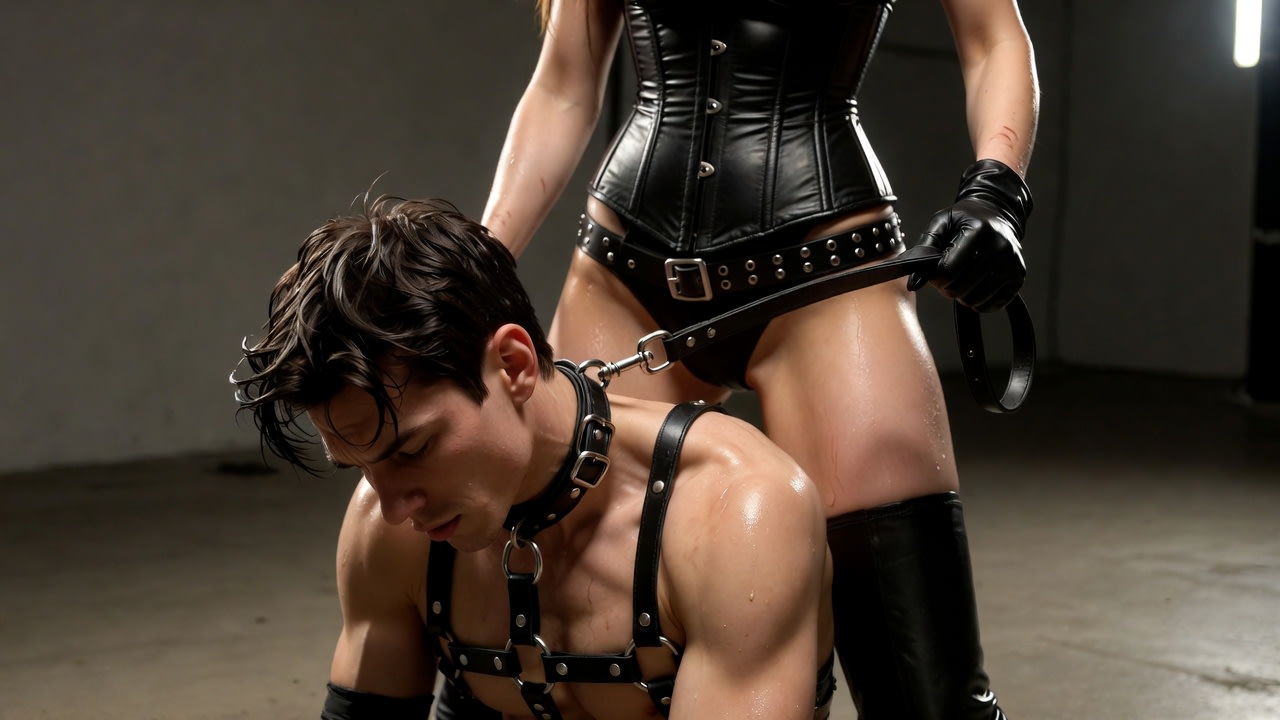
She does not pull. That is the first thing you notice, and the last thing you understand. The leash runs from her gloved hand to the ring at your throat, and most of it stays coiled — a loop of quiet leather resting against her palm like a thought she has not finished having. You are on your hands and knees. She is standing. The geometry of the moment says everything the two of you have already agreed to, and it says it without a single word.
The crawl is not glamorous. It was never meant to be. And that is exactly why it matters.
The Most Honest Posture There Is
Kneeling is elegant. Standing bound is dramatic. But the crawl — hands flat on the floor, spine long, head lowered, moving only when the lead moves — is honest in a way no other posture can be. There is no way to crawl impressively. There is no angle from which it flatters you. The body on all fours has given up its podium, its handshake height, its practiced silhouette. What remains is effort. Weight. Breath. The small sounds of a person actually working at their surrender instead of posing inside it.
This is why the crawl sits so deep in the vocabulary of power exchange. It cannot be faked gracefully. Either you are willing to be seen like this — sweating, deliberate, entirely at floor level — or you are not. The floor has a way of telling the truth about you.
Why the Floor Changes Everything
Height is language. We spend our whole lives negotiating it: who stands when someone enters the room, who looks up and who looks down, who occupies the head of the table. When you go down to all fours, you step out of that negotiation completely. You are not lower than her the way a bowed head is lower. You are lower the way an animal is lower — sincerely, structurally, with your whole body committed to the fact.
And something in the mind follows the body down. Submissives describe it again and again: the moment the palms touch the floor, the chatter thins. The strategising self, the one that manages impressions and calculates outcomes, has nothing left to manage. You cannot network from your hands and knees. You can only be there, and belong to the person holding the line.
The Coil in Her Hand
Look at the leash again. Most of it is slack. Most of it is coiled. This is not carelessness — it is fluency.
A dominant who drags her submissive across the floor is shouting. A dominant who holds the coil and lets the lead hang soft is speaking at a normal volume, because she knows she will be heard. The coil says: I could take up this slack at any moment, and we both know it, so I do not need to. Control that must constantly prove itself is not control. It is anxiety wearing a costume.
The submissive at the end of a slack lead is not less held than one pulled taut. He is more held, because what holds him is not tension in the leather but tension in the agreement — the living, chosen, hourly renewed decision to stay at her heel. The leash is a symbol wrapped around a fact. The fact is consent. The fact is trust. The leather just makes it visible.
Being Led From Behind
There is a particular intimacy in being led by someone you cannot see. When she walks behind you, you lose the ordinary reassurances — her expression, her eyes, the small facial weather that tells you how you are doing. What you have instead is the lead itself: its weight, its angle, the faint change in pressure that means slower, left, stop. You learn to listen with your throat.
This is trust with the theory removed. Anyone can say the words. But to move forward on hands and knees, guided only by a line you cannot follow to its source, is to practice the thing itself — belief in another person's attention, made physical, tested one crawling pace at a time. She watches precisely because you cannot. Her attention is the net under the whole exercise. You feel it through three feet of leather, and it is unmistakable.
Effort as Offering
Here is what the photographs never quite capture: crawling is work. The shoulders load. The knees report the floor honestly. Sweat arrives without being invited. And this, too, is part of the gift.
Surrender that costs nothing says nothing. A submissive who lounges decoratively at his domme's feet has offered her an image. A submissive who crawls the length of a room because she indicated it — slowly, carefully, breathing through the effort of it — has offered her labour. His body is doing something difficult on her behalf, and every strap of the harness across his back testifies to it. In the economy of power exchange, effort is currency. The crawl spends it openly.
This is also why the crawl builds something in the person doing it. Discipline is not assembled in comfortable positions. Each pace on the floor is a small vow kept: I said I would, and I am. Enough of those vows, kept one after another, and a submissive stops wondering whether he is devoted. He has the knees to prove it.
The One Standing Still
Spend a moment with her side of it, because the crawl is a duet even when only one body is moving. She has taken responsibility for a human being who has deliberately made himself slow, low, and dependent. His pace is her pace now. His safety is her arithmetic. The coiled lead in her hand is not a trophy; it is a task list — floor conditions, his breathing, the wear in his shoulders, the moment when pride would keep him crawling past what his body should give.
Good dominance is mostly attention. The rest is presentation. When she stands over him, boots planted, lead gathered, apparently doing nothing — she is doing the most demanding thing in the room. She is watching everything.
Beginning at the Bottom, Properly
If the crawl calls to you, let it call you slowly. Negotiate it like anything else that matters: how long, on what surface, with what signals, and what the word is that ends it instantly. Knees are not renewable. Mats and rugs are not a compromise of the aesthetic; they are what allows the aesthetic to happen again next week. A crawl of two minutes done with full presence outranks twenty minutes endured for show.
And afterwards — because there is always an afterwards — come back up in stages. Kneel first. Sit. Let the blood and the pride redistribute. Let her hands undo what her hands arranged. Aftercare is not the end of the scene. It is the second half of it, the half where everything the floor taught you gets carried back up to standing height.
The Truth at Floor Level
The world will tell you that a man on his hands and knees has been diminished. The world is reading the picture upside down. It takes a settled, deliberate kind of strength to go to the floor on purpose — to hand your pace, your height, and your direction to a woman who has earned them, and to trust the quiet coil in her hand more than the noise in your own head.
She does not pull, because she does not need to. You follow, because you chose to. That is the whole secret, and it was never really about the leash.
The floor is waiting. It has always been honest. The only question is whether you are ready to be.