Some rooms ask nothing of you. This one asks everything.
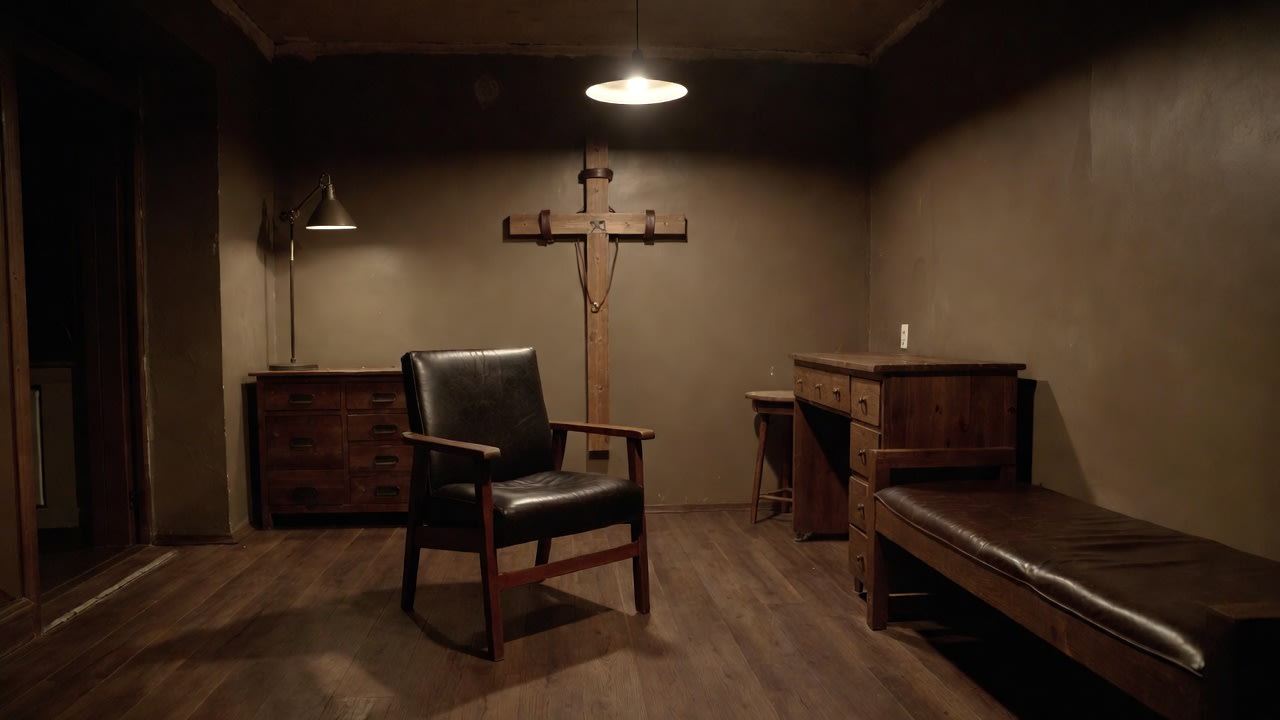
There is a particular silence to a space that has been made for surrender. You feel it before you understand it. The light is low and deliberate. The air is still. A chair waits. A cross stands against the wall, patient as a confessional. Nothing here is accidental — and that is the whole point.
People think a play space is about equipment. It isn't. You can own every cuff and flogger in the catalogue and still have a room that feels like a garage. And you can take a single corner of a small apartment and make it feel like the edge of the world. The difference is not money. It is intention.
Let me show you how a space for surrender is actually built.
A space is a promise the room makes
When a submissive crosses into a space that has been prepared for them, something shifts in the body before the mind catches up. Shoulders drop. Breath slows. The ordinary self — the one that answers emails and worries about Tuesday — is asked, gently, to wait outside.
That shift is not magic. It is design. A room built for power exchange works the way a chapel works, or a good restaurant, or a quiet consulting room. It tells you, through light and texture and arrangement, what kind of person you are allowed to be while you are inside it.
This is the first principle, and the most important one: the room is not for the gear. The room is for the surrender. Everything else serves that.
You do not need a dungeon
Forget, for a moment, the image of a black-walled basement full of chains. Most real spaces for surrender are far quieter than that. A reading chair with good leather and a low lamp. A bench at the foot of the bed. A single hook in a closet doorway. A drawer that only opens for one reason.
What matters is not scale. It is threshold — the sense of crossing from one world into another.
Start with one object
If you are building your first space, do not begin with a shopping list. Begin with one object that means something. A collar that lives on a particular shelf. A cushion that is only ever used for kneeling. A chair the Dominant sits in and no one else does.
One object, used with consistency, becomes a doorway. The submissive learns its meaning through repetition, not explanation. Soon the object alone is enough to begin the descent.
The architecture of power exchange
Walk into a room built for this and read it like a sentence. A pendant light hangs low, pooling warmth in the centre and leaving the edges in shadow. There is a leather chair — upright, composed, a place for the one who watches. There is a bench, padded and waiting, lower than the chair. And on the wall, a wooden cross, simple and unmistakable.
Notice what the room is saying. The heights are not equal. The light has a centre. The hard surfaces and the soft ones are placed in conversation. This is the grammar of power exchange written into furniture.
Height tells the story
In almost every dynamic, level matters. The one who stands or sits high holds the frame. The one who kneels, lies, or waits low gives it up. You do not need to say a word about this — let the furniture speak. A chair and a cushion at its feet say more than a paragraph of protocol ever could.
Light is a leash
Bright, flat overhead light kills surrender. It exposes everything and suggests nothing. Warm, directional, low light does the opposite — it draws a circle, narrows the world, makes the room feel like a held breath. A single dimmable lamp will transform a space faster than anything you can buy in a fetish shop.
Texture is memory
Leather, wood, cold metal, soft rope, smooth stone. The body remembers texture long after it forgets words. A space that plays with contrast — the give of a padded bench against the unyielding line of a wooden cross — keeps the senses awake and the mind submitted. Build for the skin, not only for the eye.
Privacy is the foundation, not a feature
None of this works if part of you is listening for footsteps in the hall. Surrender requires safety, and safety begins with a door that closes and a reasonable certainty that the world will not walk in.
If you share your home, this is a conversation before it is a renovation. A lock. An agreed signal. A window of time when the space is yours. A submissive cannot let go in a place where they are bracing. Privacy is not an upgrade you add later — it is the floor the whole room stands on.
The pack-away space
Many people do not have a room to dedicate, and that is perfectly fine. A space for surrender can live in a box under the bed and be assembled in five minutes. The ritual of setting it out — laying the cushion, lighting the lamp, placing the collar — becomes part of the scene itself. Building the room can be the first act of submission. Taking it down, the last.
The room remembers what you do in it
Here is something people discover only with time: a space accumulates meaning. The chair where the Dominant always sits begins to carry authority even when it is empty. The corner where kneeling happens starts to pull at the knees on its own. You are not only arranging furniture. You are training a room, and the room trains you back.
This is why consistency matters more than complexity. A simple space used the same way, again and again, grows powerful. An elaborate space used carelessly stays cold. Ritual is what turns square metres into a threshold.
Care lives in the room too
A space built only for intensity is incomplete. The same room that holds the scene must hold what comes after — the slow return, the water, the blanket, the quiet. Keep softness within reach. A folded throw. A bottle of water. A low seat where two people can simply sit while the world comes back into focus.
Aftercare is not separate from the design. The most thoughtfully built spaces plan for the descent and the climb back with equal care. The room should be able to hold you when you are undone, not only when you are commanding.
Begin where you are
You do not need a basement, a budget, or permission to want this. You need a door that closes, a light you can lower, one object that means something, and the intention to make a place where surrender is allowed to happen.
Start small. One chair. One cushion. One lamp. Use them the same way until the room learns its purpose. Add only what deepens the meaning, never what merely fills the space.
The room where surrender lives is not bought. It is built — slowly, deliberately, with attention. And once it exists, you will find that you do not enter it the way you enter other rooms. You arrive differently. You leave differently.
That is the whole craft. Build the threshold, and let it do its quiet work.
— Mistress Krigar