Buckled In: The Leather Harness and the Art of Being Worn
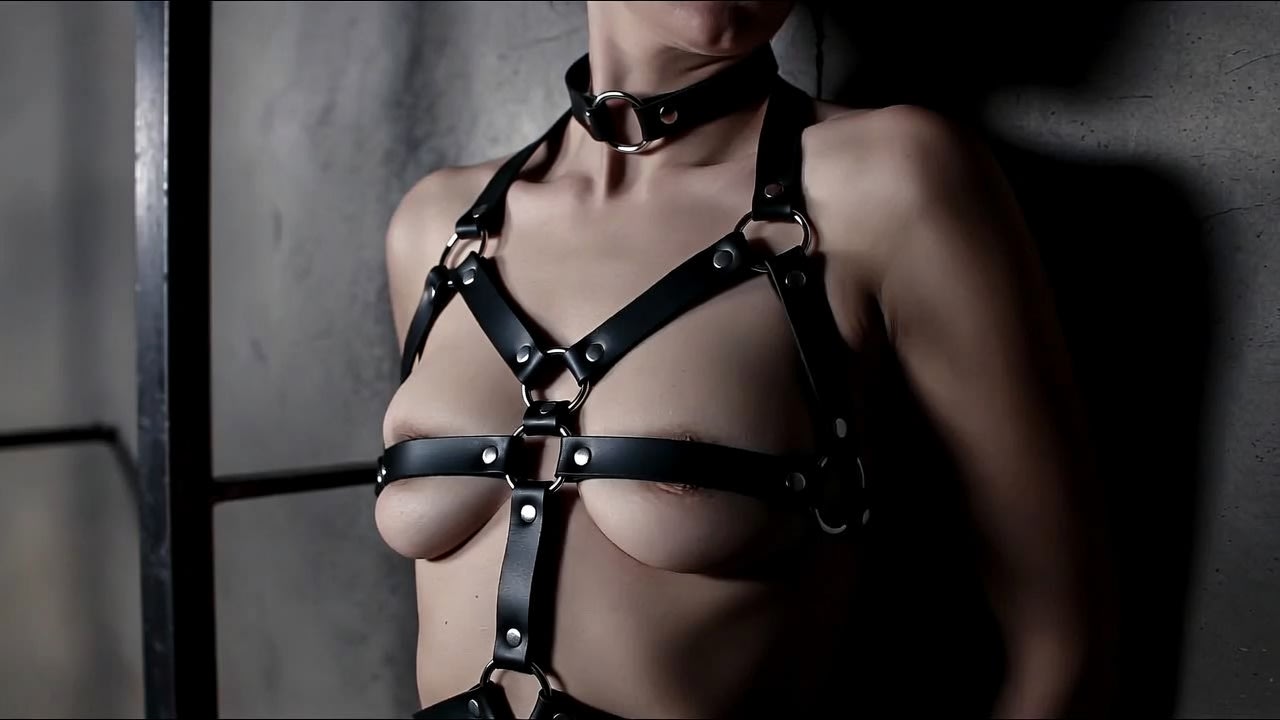
She stands against the concrete and does not move. The light finds the leather first — the straps crossing her chest, the O-ring resting cold at her throat — and only then does it find her stillness. That is the part most people overlook. Before anything is done to her, before a single word is spoken, she is already answering. She is wearing the harness. And to wear it well is its own quiet form of obedience.
Let me tell you what a harness actually is. Not what it looks like in a shop window. What it is, once it is on you.
A Harness Is Not Decoration
Lingerie asks to be looked at. A harness asks something harder. It draws lines across the body — shoulders, sternum, the arch of the ribs, the soft plane below — and where each line falls, it says something. Here. And here. This is where you have agreed to be held.
That is why leather is the right material and not a coincidence. Leather does not flatter the way silk does. It holds a shape. It warms slowly to your skin and keeps that warmth. It creaks a little when you breathe, so you become aware of your own breathing in a way you rarely are. Every strap is a decision someone made about your body. Every buckle is a small vow you can feel against yourself all evening, long after you have stopped thinking about how you look.
A harness is not there to reveal you. It is there to frame you — to take the body you already have and draw a border around it, so that both of you know exactly what is inside the lines.
The Ritual of Being Buckled In
The most underrated moment in this entire dynamic is the moment before the scene. The buckling in.
It is slow on purpose. A good Dominant does not rush the straps. She lifts your arm, threads the leather, sets the buckle, and tightens it one hole at a time until it sits the way she wants it — not the way you would have chosen. You stand and you let it happen. You do not help unless asked. You do not fidget the strap into a more comfortable place. You simply hold still and let yourself be arranged.
Something happens to the mind in those minutes. The noise quiets. The endless internal negotiation — what should I do, what does she want, am I doing this right — begins to fall away, because the answer becomes very simple. Stand. Breathe. Be dressed by another set of hands. The harness is not only restraint of the body. It is the first restraint of the mind, and often the more welcome of the two.
Why the tightness matters
There is a specific comfort in a strap that is snug. Not painful — snug. The pressure is constant, unarguable, and honest. It does not change its mind. Many submissives describe it as the feeling of being held together, as if the leather is doing the work their own tense shoulders have been doing all week. The harness says: you can stop bracing now. I have you. That is the whole trick of it. Restriction, offered the right way, feels like relief.
The O-Ring at the Throat
Look again at the collar. The single steel ring, resting in the notch of the throat, exactly where a hand or a lead would go.
The O-ring is not idle hardware. It is an invitation and a promise at once. It marks the throat as the place where control is offered — the most vulnerable line on the whole body, given freely, ringed in metal so no one has to wonder. When it is empty, it waits. When a finger hooks through it, the message travels the length of the spine before a word is said.
This is the language of the harness in miniature. Nothing crude. Nothing forced. A ring, a pause, and a body that has already decided the answer is yes.
Stillness Is the Loudest Thing in the Room
Return to her against the wall. She is not tied to anything. No rope holds her to the concrete. She could step away. And that is precisely the point — she stays because she chose the harness, and choosing it means choosing the stillness that comes with it.
People new to this imagine that surrender is a dramatic thing, full of struggle and noise. It is usually the opposite. The deepest submission I have ever witnessed is quiet. It looks like a woman standing very straight in leather, waiting, her breath even, her eyes soft, giving nothing away and offering everything. The stillness is not emptiness. It is attention held at full tension, like a drawn bow that has not yet been released.
To hold still while wearing a harness is to say: I am ready, and I will wait for you to decide when. There is enormous power in that waiting — and, if you are paying attention, enormous power in being the one waited for.
Trust Is the Real Buckle
None of this works without the thing you cannot see in the photograph. Trust.
A harness only becomes surrender when it is put on willingly, by hands that have earned the right to arrange you. The straps are easy. The trust is the work. It is built in conversation before it is ever built in leather — in the boundaries you name out loud, the safeword you agree on and mean, the check-in that happens whether or not the mood wants to be interrupted. The most competent Dominant in the world is worth nothing to you if she has not first made you feel safe enough to go still.
So before you buy the harness, have the conversation. What is welcome. What is not. What the word is that stops everything, instantly, no explanation required. Power exchange is not the absence of rules. It is a very precise set of rules, agreed on by both people, inside which one of them gets to stop deciding for a while. That is the luxury being offered here — not nakedness, not spectacle. The luxury of being held so well and so deliberately that you can finally let go.
What the Leather Remembers
Afterward, the harness comes off as slowly as it went on. The buckles loosen one at a time. The skin remembers the straps for a while — faint lines that fade, warmth that lingers, a body that feels curiously light now that it is no longer framed. This is the part no one photographs and everyone should honor: the coming back. Water. A blanket. A quiet voice. The same hands that arranged you, now steadying you.
Good aftercare is not an afterthought. It is the closing bracket of the sentence the harness began. You were held; now you are held differently. That symmetry is what makes the whole thing feel like devotion rather than performance.
Wear It Like You Mean It
So here is what I want you to take from a single image of a woman in leather against a grey wall. The harness is not the point. The stillness inside it is. Anyone can buckle on a set of straps. Far fewer can stand quietly in them and mean it — can let themselves be mapped, framed, and held, and find relief rather than fear in the tightness.
If that stillness calls to something in you, do not be ashamed of it. That pull is not weakness. It is a very old, very clean desire to be arranged by someone you trust and to stop, for a while, being the one who decides. Name it. Talk about it. Find the hands worth trusting. And when you are ready, stand against the wall, let the leather find your breath, and wear it like you mean it.
— Mistress Krigar