We imagine surrender takes place in the dark.
Black rooms. Cold floors. Steel that bites. The whole vocabulary of submission seems to live underground, somewhere stripped of comfort, where the body is tested rather than held. And there is a place for that. I will never tell you otherwise.
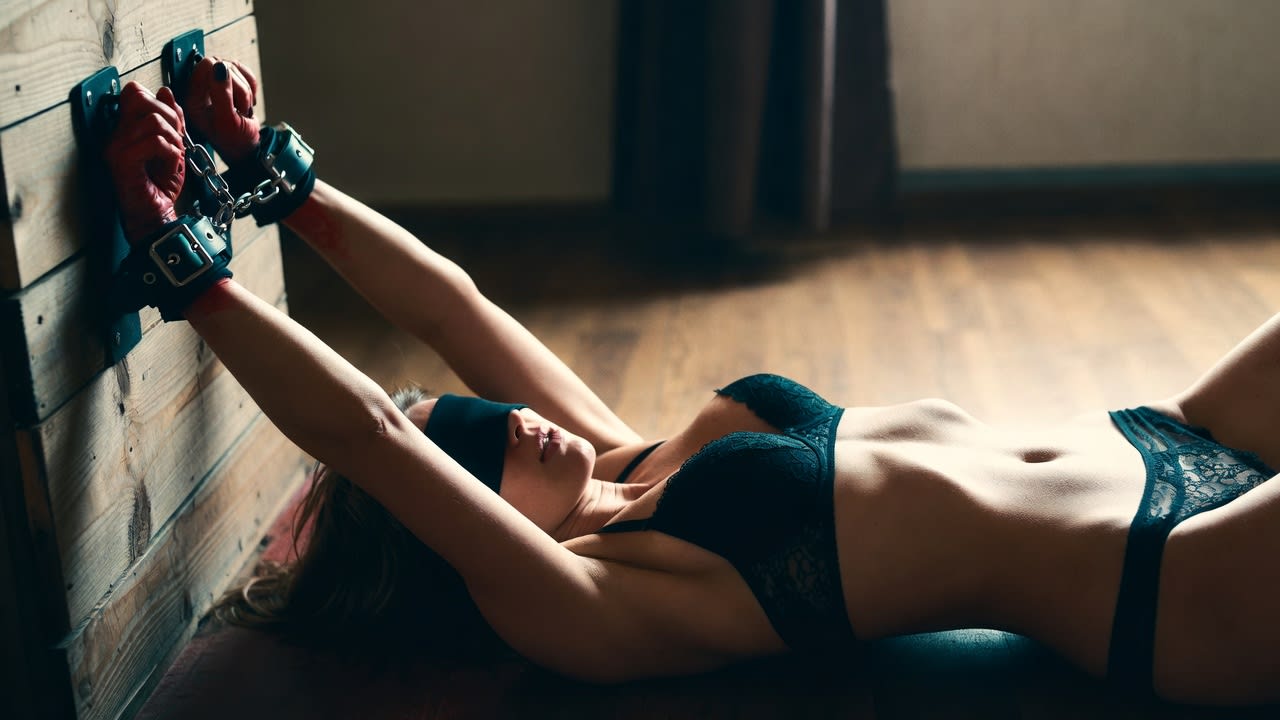
But the deepest letting-go I have witnessed did not happen in a dungeon. It happened in a warm room, in the late afternoon, with daylight coming low through a window and falling across the floor. Soft lace against rough wood. A blindfold. Two cuffs. A short length of chain anchored to the wall, holding a pair of wrists exactly where they had agreed to stay.
Nothing punishing. Nothing theatrical. Just a body stretched out in the light, arched and open, waiting.
That is what I want to talk about today.
The Myth of the Dark Room
There is a story we tell ourselves about power exchange: that it has to be severe to be real. That if it doesn't hurt, it doesn't count. That surrender must be earned through cold and discomfort, or it is somehow soft, lesser, not the genuine article.
I find this story tedious.
Surrender is not measured by how harsh the setting is. It is measured by how completely you let go inside it. And letting go is often easier, deeper, more honest when you feel safe enough to stop bracing. Warmth does not dilute submission. It distills it. Take away the cold and the spectacle, and what remains is the real thing: a person choosing to be held still, and meaning it.
The dark room can be a costume. The warm one leaves you nowhere to hide.
What the Light Asks of You
There is a particular vulnerability in being restrained in daylight.
In the dark, you can disappear. The shadows do half the work. You can imagine yourself unseen, anonymous, dissolved into the black. But in a warm, sunlit room, every line of you is visible. The arch of the spine. The stretch of the arms above the head. The rise and fall of breath you cannot quite slow down. You are not hidden. You are shown.
And the blindfold makes a beautiful inversion of this. You cannot see — but you can be seen. You give up your own gaze and surrender to being looked at. That asymmetry is the whole charge of it. You lie there, lit and exposed, with no idea what is being noticed, what is being decided, what is coming next. You can only feel.
This is not a small thing to offer. To be bound in the light is to say: look at me, all of me, while I cannot look back. Few gestures of trust are more complete.
The Anchor and the Chain
Notice the chain. Short. Anchored low to the wall. It does not drag you anywhere. It does not strain. It simply holds your wrists in one place and says: here.
People new to restraint often think the point is force — that the cuffs are there to make you stay. They are not. A determined person can fight almost any simple binding. The cuffs are not a cage. They are a decision made visible. You agreed to stay. The chain only reminds your body of what your will already chose.
That is why a short anchor against a wall can undo someone more thoroughly than the most elaborate suspension. It is honest. There is no spectacle to perform, no rope artistry to admire. There is only the plain fact of being kept, gently and completely, exactly where you said you would remain.
When the fighting stops — when the wrists settle into the cuffs and the shoulders finally drop — that is the moment. That softening is the surrender. Everything before it was just arriving.
Lace Against Wood
I keep returning to the texture of it. Fine lace on the skin. Rough, sun-warmed wood beneath. Soft leather at the wrists. The contrast is the point.
Surrender lives in contrast. The delicate and the unyielding, pressed together. The body that could rise but chooses to stay down. The mouth that could speak the word but holds it, for now, because holding it is its own kind of pleasure. We are not made of one thing. We are made of the tension between softness and steel, and good power exchange plays that tension like an instrument.
Dress the part if it pleases you. Lace, leather, bare skin — let the surfaces matter. Sensation begins long before anything is done to you. It begins in the texture of the floor, the weight of the cuff, the cool buckle against a warm pulse. Pay attention to these small things. They are not decoration. They are the language.
Anticipation Is the Real Scene
Here is what most people get wrong. They think the scene is what happens after — the touch, the command, the release. But the truest part of submission is the waiting that comes first.
Bound, blindfolded, arched in the warm light, you have nothing to do but anticipate. And anticipation is a furnace. Every sound becomes enormous. A footstep. A breath. The faint creak of weight shifting on old wood. Deprived of sight, your skin grows ears. The air itself starts to feel like contact.
This is why I am rarely in a hurry. To rush past the waiting is to throw away the best of it. I will let a held breath stretch until it trembles. I will let the silence do my work for me. The longer the pause, the more completely you hand yourself over — not because you are forced to, but because the not-knowing becomes unbearable and delicious in equal measure, and surrender becomes the only relief.
Patience is not the absence of intensity. Patience is the intensity.
Trust Is the Whole Architecture
None of this works without trust. None of it.
A blindfold on someone who does not feel safe is just sensory deprivation — disorienting, hollow, a little cruel. A blindfold on someone who trusts you completely is a doorway. Same cloth. Entirely different world. The difference is built long before the lights go low, in every smaller promise you have kept.
So if you are new to this, begin there. Not with the chain. With the conversation. What is wanted. What is forbidden. The word that stops everything, honored instantly, every single time, no exceptions and no negotiation. Restraint without that foundation is not power exchange. It is just risk.
A safeword is never a failure of the scene. It is the structure that lets the scene exist at all. The person who can stop everything with a single word is, in truth, the one holding the most power in the room. I want them to know that. I want them to feel it underneath them like a floor. Only then can they truly fall.
How to Begin, If You Are New
You do not need a dungeon. You do not need a wall of equipment. You need a warm room, a quiet hour, and someone you trust.
Start small. A blindfold and a pair of soft cuffs are enough for a lifetime of discovery. Talk first — fully, plainly, without embarrassment. Agree on the word that stops everything. Then let one of you give up the gaze, and the other take up the watching. Go slowly. Let the waiting do its work. Notice the textures. Notice the breath. Notice the exact moment the body stops bracing and finally lets itself be held.
You do not have to suffer to surrender. You only have to trust enough to stop holding yourself up.
The Quiet at the Center
There is a stillness that arrives when restraint is done with care. The mind, so used to running, finally goes quiet. The endless management of the self — the posture, the performance, the deciding — is set down. Someone else is holding the shape of the moment now, and you are free, for once, to simply be inside it.
That quiet is the gift. Not the cuffs, not the chain, not the blindfold. Those are only the means. The gift is the silence they make possible — the rare, warm, sunlit silence of a person who has handed themselves over completely and, for a little while, has nothing left to carry.
Surrender does not belong to the dark.
Sometimes it happens in the warmest light you have ever felt on your skin.
— Mistress Krigar