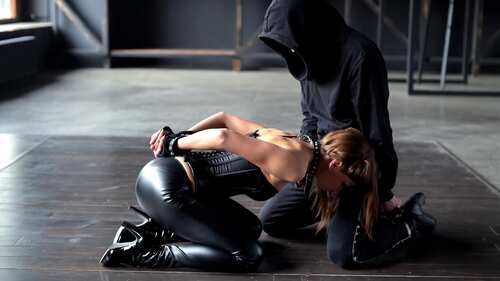
There is a moment, just after the cuffs close, when nothing has happened yet. No command has been given. No hand has moved. You are simply there — wrists bound behind you, knees against the floor, waiting for whatever comes next. Most people rush past this moment. They think the scene begins when the first instruction is given, when the flogger falls, when the collar clicks shut. They are wrong. The scene begins in the stillness. It begins the instant you stop deciding what happens next.
This is the part no one warns you about when they talk about submission: how much of it is waiting. Not performing. Not proving anything. Just waiting, bound, breathing, present.
The Floor Is Not a Punishment
People new to this often misread the floor. They think kneeling is about being lowered, about being made small. It isn't. The floor is where you stop managing the room. Standing, you are still half in control — weight on your own feet, spine doing its usual work, eyes free to scan for exits and explanations. Kneeling, with your wrists already fastened behind you, you hand that off. Someone else is now responsible for what happens to your body. That is not smallness. That is trust with a shape you can feel in your shoulders.
I have watched hundreds of first-timers discover this. They expect fear. What arrives instead, usually within the first few minutes, is something closer to relief — the specific, physical relief of a body that has stopped negotiating with itself.
What the Wrists Know Before the Mind Does
Bind someone's wrists and something changes in how they carry their chest. The shoulders draw back. The sternum lifts, almost involuntarily. It is not a pose. It is the body rearranging itself around a simple fact: the hands are no longer available for defense, for adjustment, for quietly fixing whatever feels exposed. There is nothing to fix anymore. There is only what is being done to you, and what you choose to do with your attention while it happens.
This is where discipline actually lives — not in gritted teeth, not in performance, but in the willingness to stay soft in a position your instincts call vulnerable. Anyone can hold still when nothing is being asked of them. The discipline is in holding still because something is being asked, and choosing to answer with stillness rather than resistance.
Stillness Is Not the Absence of Feeling
Let me be precise, because this gets misunderstood constantly. Stillness is not numbness. It is not dissociation, and it is not performance of calm you don't feel. The stillness I ask for — the stillness worth building toward — is a body that keeps feeling everything and simply stops fighting it. The pulse still spikes. The breath still catches. What stops is the reflex to escape the sensation. That reflex is loud, and it is old, and unlearning it is real work. Anyone who tells you surrender is easy has never actually done it.
The Hood, and Why Anonymity Sharpens Focus
There is a particular intensity that arrives when the one holding you is partly hidden — a hood pulled low, a face given up to shadow. It unsettles people at first. They want to see who is in control of them, want the reassurance of an expression to read. But take that reassurance away, and something sharpens. You stop watching a face for permission and start listening to the room instead — to breath, to the small shifts of weight, to the tone under the words rather than the words themselves. Anonymity strips away the performance of dominance and leaves only its function: attention, decision, and the steady hand that either tightens a strap or loosens it, based on what your body is actually telling them, not on what you think you should be showing.
This is intimacy of a stranger kind. You are not being seen and reassured. You are being read. And being read correctly, by someone who is paying real attention, does something that eye contact rarely manages: it makes you feel entirely, uncomfortably, exactly known.
The Discipline of Waiting
Every scene has dead air in it — the pause while a buckle is checked, the silence while she decides what comes next, the stretch of time after one sensation ends and before another begins. New submissives fill this air. They shift, they speak, they ask if everything is alright, they try to be useful. It is an old habit: fill the silence, manage the moment, stay in charge of something.
Waiting well — kneeling, bound, unfilled — is its own discipline, and it is harder than most of the visible parts of submission. It asks you to tolerate uncertainty without resolving it yourself. It asks you to let someone else's timeline become your timeline. Do this enough times and something in you loosens permanently. You start to trust that the silence is not abandonment. It is simply someone else, thinking, deciding, in no hurry to explain themselves to you.
That patience is not passive. It takes more focus to wait well than to perform well. A submissive who can hold stillness through five full minutes of nothing happening has done more real work than one who can take a hard scene but cannot bear thirty seconds of quiet.
What This Teaches Outside the Room
People assume this practice stays contained to the hour it happens in. It does not. Learn to sit still in your own uncertainty — bound, kneeling, unable to fix the moment with your hands — and you start to recognize the same reflex everywhere else in your life. The urge to fill silence in a difficult conversation. The urge to manage an outcome that was never yours to control. The urge to perform composure instead of actually finding it.
Surrender, practiced honestly, is training in exactly one thing: the ability to stay present inside something you are not steering. Most of adult life asks the opposite of us constantly — steer, manage, optimize, fix. A single hour on your knees, wrists bound, breath slowing to match a rhythm someone else set, is a strange and specific antidote to that. It is not escape. It is recalibration.
What I Ask of You
If you take one thing from this: the floor is not where you lose yourself. It is where you stop performing yourself long enough to feel what is actually there. The bound wrists are not the point. The waiting is not the point. The point is what happens in you when you finally stop trying to be in charge of a moment that was never asking that of you in the first place.
Kneel. Breathe. Let the silence be silence. I will tell you what comes next when it is time — not before.
— Mistress Krigar