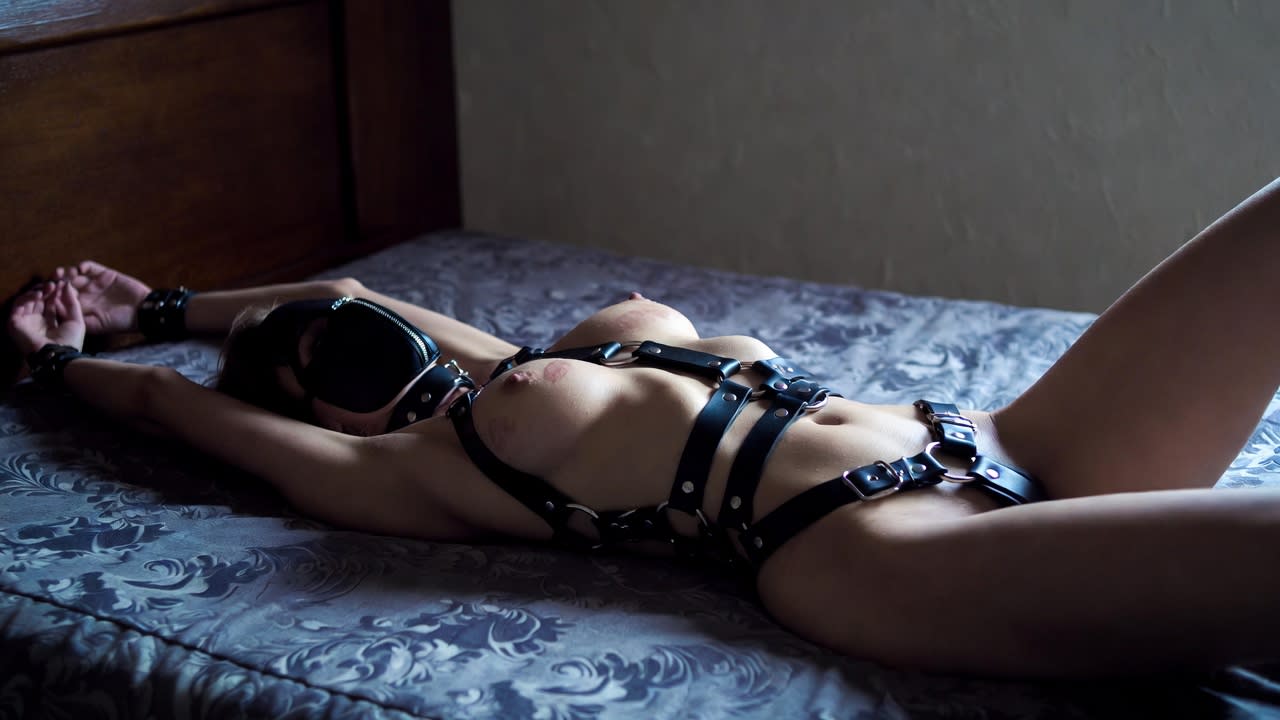
She is lying on the bed. Wrists cuffed above her head. A blindfold where her eyes should be. Leather straps crossing her body like a map someone else drew. She is not going anywhere, and that is precisely the point.
Look at her for a moment. Not at the harness. Not at the cuffs. Look at how still she is. That stillness was not forced. It was given. And in my experience, it is one of the most beautiful things a submissive can offer — because it cannot be faked, and it cannot be rushed.
This is a piece about the blindfold, the restraint, and the long quiet minutes in between. About what happens inside a person when you take away their sight and their movement and leave them with nothing but their own breath and the certainty that someone is watching over them. It is about sensory surrender — and why, done well, it is less about darkness and more about light.
What the Blindfold Actually Takes
Most people think a blindfold removes sight. That is the smallest thing it removes.
Sight is how we manage. It is how we anticipate, calculate, prepare. The eyes are always working — scanning the room, reading the face across from us, measuring distance, predicting the next moment before it arrives. Vision is control's favorite instrument. We steer our whole lives through it.
So when the blindfold settles into place, what is really taken is the ability to prepare. The next touch cannot be seen coming. The next sound cannot be matched to a movement. Time itself goes soft at the edges. A minute in darkness is not the same length as a minute in light. Anyone who has worn a blindfold in trusted hands knows this: the world does not shrink. It deepens.
The Senses That Wake Up
Take one sense away and the others lean in. This is not poetry; it is how the nervous system works. In the dark, skin becomes articulate. The air moving when someone crosses the room becomes an event. A footstep on the floorboard is a whole sentence. The faint creak of leather, the pause before contact — each one lands with a weight it would never have in daylight.
The blindfolded body listens with everything it has. And a body that is listening that closely is a body that is entirely, completely present. No phone. No mirror. No self-consciousness about how one looks. The blindfold is, among other things, a mercy: it takes away the performance and leaves only the experience.
Restraint Is a Sentence With Two Authors
Now add the cuffs.
Restraint has a reputation for being about force. It is not. Nothing about a soft cuff and a buckle could hold anyone who truly wished to leave. The restraint is not the leather. The restraint is the agreement. The leather is only the symbol of it — the physical form of a sentence two people wrote together: you will stay, because you choose to, and I will hold that choice with both hands.
This is what people outside the lifestyle so often miss. They see the harness and think of captivity. Those of us inside it see the opposite. A person in well-placed restraints is one of the freest people in the room. Free from decision. Free from vigilance. Free from the exhausting, lifelong job of being in charge of themselves. For one hour, someone else is keeping watch — someone chosen, someone trusted, someone who asked the right questions first and listened to the answers.
The Stillness Underneath
There is a particular moment I want you to understand. It comes a few minutes in. The first small tugs against the cuffs are over — the testing, the settling, the little negotiations between body and buckle. And then something lets go. The shoulders drop. The breath lengthens. The body stops asking what if and starts asking nothing at all.
That is the moment surrender actually happens. Not when the cuffs close. When the questions stop.
Some call it subspace. I call it arrival. The mind, so used to running ahead of the body, finally comes back and lies down inside it. For some, it is the quietest their head has been in weeks. This is one of the honest reasons people return to submission again and again — not the intensity, though the intensity is real, but the silence. The deep, warm, held silence of not being in charge.
Anticipation: The Longest Touch
Here is a secret every experienced dominant knows: the most powerful touch is the one that has not happened yet.
In the dark, waiting is not empty. Waiting is full. Every second stretches and shimmers with possibility. Will the next contact be fingertips or breath? Near or far? Now — or in a moment that refuses to arrive on schedule? The blindfolded, bound body lives entirely inside that question, and the question itself becomes the sensation. Anticipation is a touch that lasts for minutes.
This is why the skilled ones move slowly. Why they let the silence sit. Why they cross the room and then simply stand there, letting their presence be felt before their hands are. To rush the dark is to waste it. The wait is not the space between the good parts. The wait is the good part — the tension drawn out like a note held long past comfort, until the whole body is nothing but attention.
Trust Is Built Before the Blindfold, Not After
None of this works without one ingredient, and it is not leather.
Everything in that image — the stillness, the softness, the surrender — was built earlier, in full light, with clear eyes and clear words. The conversation about limits. The agreed signals, because a blindfolded mouth must always have a word that stops the world. The aftercare that was promised before it was needed. Consent is not the paperwork of desire; it is the architecture of it. The dark is only safe because the light did its work first.
So if you are new and this image stirs something in you, understand: you are not looking at a beginning. You are looking at a result. The trust came first. It always comes first.
For the One Who Wants to Be Where She Is
Start smaller than you think you should. A scarf over the eyes for ten minutes, hands free. Learn what your mind does in the dark before you add the cuffs. Speak your limits plainly — a submissive who states their boundaries clearly is not less submissive; they are more valuable. Surrender that cannot say no is not surrender. It is only drift.
For the One Who Would Hold the Watch
Your job in that room is larger than it looks. When you take someone's sight and movement, you inherit their vigilance. You are now the one watching the door, reading the breath, counting the minutes. Check in. Move deliberately. Be worthy of the stillness you have been handed — because it is the most expensive thing they own.
The Quiet Power
Return to her one last time. Cuffed, blindfolded, still. The room is dim and the house is quiet and somewhere just out of frame, someone is watching over her with complete attention.
Power exchange, at its best, is exactly this: one person brave enough to let go, one person steady enough to hold on, and between them a darkness that is not empty at all — but full of listening, full of waiting, full of trust.
The blindfold does not take the light away.
It moves it inside.
— Mistress Krigar