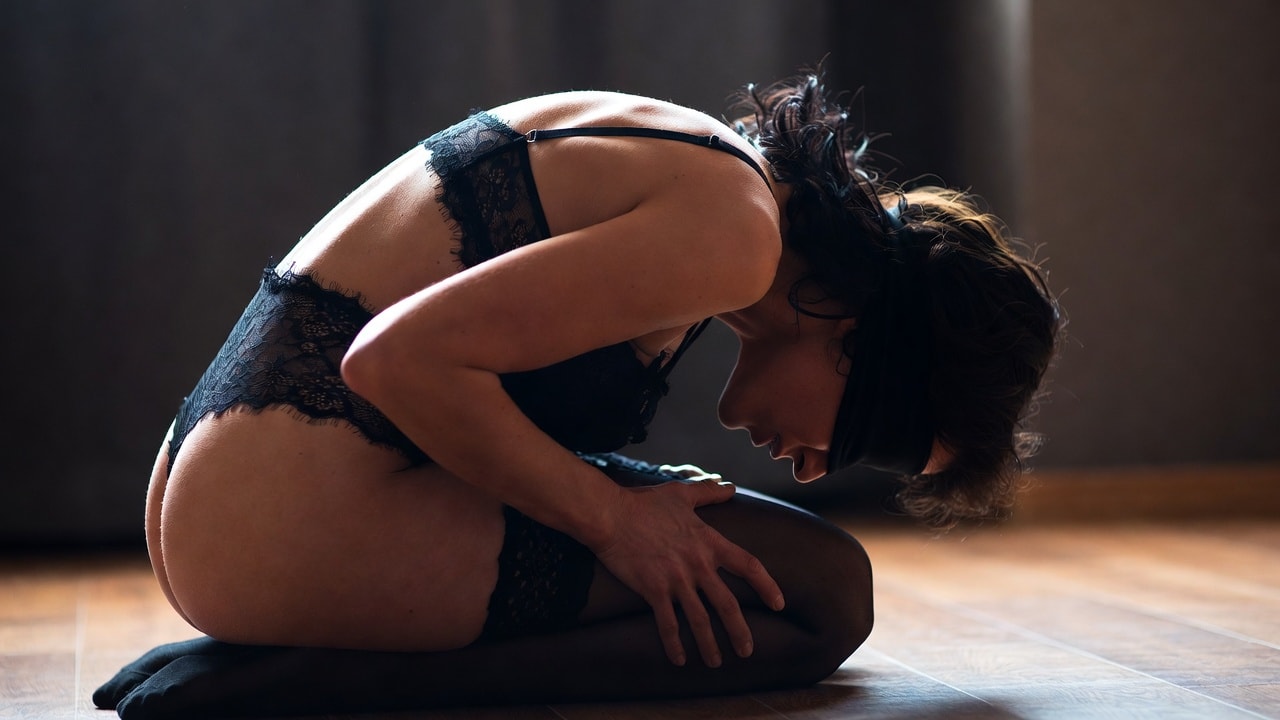
Look at her. Or rather — notice that she cannot look at you.
A strip of black fabric. That is all it is. It weighs a few grams. It costs almost nothing. And yet the moment it is tied, the whole room changes. The floor becomes more real under her knees. The light on her back becomes something she can only feel, not see. Her breath slows, because there is nothing left to watch for. There is only waiting.
This is what I want to talk about today. Not the blindfold as an accessory. The blindfold as a door.
What the Blindfold Actually Takes
Sight is the sense of control. It is how we scan, predict, prepare. It is how we stay one step ahead of the world. From the moment you wake, your eyes are working — checking, measuring, guarding.
When I remove sight, I am not taking away a sense. I am taking away a job. The job of vigilance. The job of anticipating what comes next so that nothing can surprise you.
Most people carry that job everywhere. Into their work. Into their beds. Into their own heads at three in the morning. They have forgotten what it feels like to be somewhere without watching over it.
The blindfold ends the watch. And what remains, when the watching stops, is presence. Skin. Breath. The sound of footsteps that may be approaching or may be moving away. Time, suddenly thick and slow, like honey.
The Deepening of Everything Else
Ask anyone who has knelt in darkness and they will tell you the same thing: the world does not shrink. It sharpens.
The creak of a floorboard becomes an event. The warmth of a hand hovering — not touching, only hovering — becomes almost unbearable in its gentleness. A voice, low and unhurried, lands differently when it is the only map you have.
Sound
Without sight, hearing takes the lead. She learns my footsteps. She learns the difference between the pause that means I am considering and the pause that means I am pleased. A whole language grows in the dark, and she becomes fluent in it faster than she expects.
Touch
Touch that cannot be seen coming cannot be braced for. That is the point. Every contact arrives as itself — undiluted by prediction. Fingertips on a shoulder. Fabric drawn slowly across an arm. Nothing dramatic is required. The darkness does the amplifying for me.
Time
And then there is waiting. The most underrated instrument I own. A minute of silence, blindfolded, is not a minute. It is a small eternity in which she has nothing to do but feel her own heartbeat and remember why she chose this. Anticipation is not the opposite of satisfaction. It is the first half of it.
Why This Requires More Trust, Not Less
Here is what the picture above does not show you, and what matters most: everything that happened before the blindfold was tied.
The conversation. The limits, spoken plainly and received without flinching. The safeword, agreed and honoured. The quiet understanding that the fabric comes off the moment she wishes it off — no negotiation, no disappointment, no price.
Surrender is not something that can be taken. It can only be given, and it is only worth anything when it is given freely, by an adult who knows exactly what she is offering and to whom.
That is why the blindfold is a milestone in a dynamic, not a starting point. You do not hand your sight to a stranger. You hand it to someone who has proven — slowly, consistently, boringly, beautifully — that they can be trusted with the smaller things first. Trust is built in daylight before it is spent in darkness.
The Posture of Waiting
Kneeling, folded forward, hands resting. Some see this posture and think of smallness. They are reading it wrong.
It takes strength to be still. It takes a particular kind of courage to fold yourself down onto a wooden floor and simply wait, unhurried and unafraid, while someone else decides the rhythm of the next hour. There is nothing weak in that shape. It is the shape of a person who has put down the exhausting armour of self-management and let someone else hold the perimeter for a while.
This is what outsiders rarely understand about submission: it is not an absence of will. It is will, aimed. She chose the floor. She chose the fabric over her eyes. She chose the person whose footsteps she is listening for. Every second of her stillness is an active, ongoing yes.
And that yes is deilig — unhurried, intentional, complete.
For Those Who Hold the Other End
If you are the one who ties the blindfold, understand what you have been given. Not a toy. A watch to stand.
When she cannot see, you see for both of you. You track the room, the temperature, the time, the small signals in her breathing and her hands. Dominance in that moment is mostly attentiveness wearing a confident face. The calm voice. The deliberate pace. The discipline never to waste the trust on carelessness.
Move slowly. Speak so she always knows where you are. Check in without breaking the spell — a hand on the shoulder can be a question, and a settling of her breath can be the answer. The art is in reading her as closely as she is listening to you.
And when it ends, end it well. Light returns gently. Words return gently. What happened in the dark is honoured in the light — this is aftercare, and it is not optional. It is the second half of the promise.
Beginning in the Dark
If this speaks to something in you — the pull of stillness, the relief of not watching, the sweetness of a wait you did not choose the length of — begin simply.
Talk first. Longer than you think you need to. Choose a soft blindfold and a hard boundary. Start with minutes, not hours. Let the dark be small before it is deep. Notice what rises in you when sight is gone: for some it is calm, for some it is electricity, for many it is both, braided together.
There is no rush. There is never a rush. The whole point of this practice is that the clock belongs to someone else now, and the someone else is patient.
Close your eyes. Listen.
Good. That is where it begins.
— Mistress Krigar