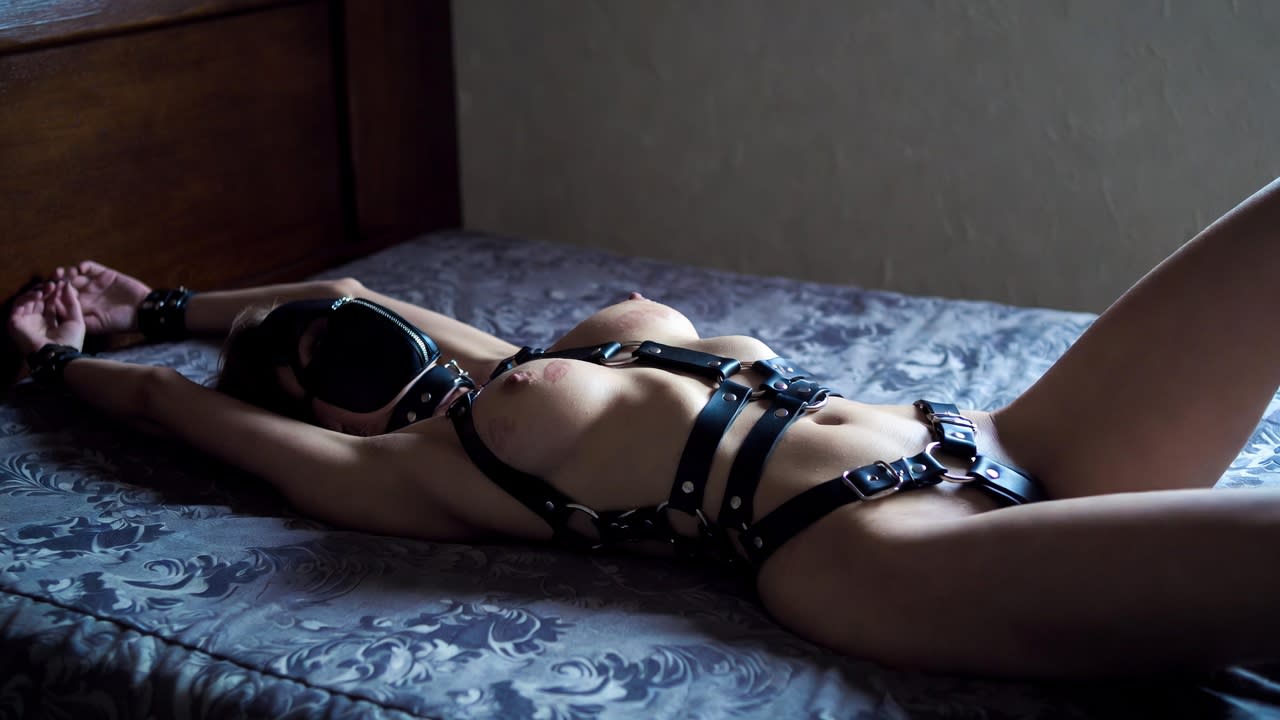
She is lying still. Blindfolded, held in leather, breathing slow on a bed that has stopped being furniture and started being an altar. Nothing is happening. Everything is happening. This is the moment most people never see — the long, deliberate hush before anything begins, when the eyes are closed for her and the only thing left to do is feel.
We talk a great deal about what submission looks like. We rarely talk about what it removes. Tonight, let's talk about the dark.
The First Thing We Take Is the Eyes
There is a reason the blindfold comes first.
Sight is the sense that keeps you managing. With open eyes you anticipate, you brace, you perform. You watch a hand move and your body decides in advance how to receive it. The blindfold ends all of that. It takes away the one sense you use to stay in control of the room, and in doing so it hands you something most people spend their whole lives avoiding: the present moment, with no exit.
When the world goes black, the body gets louder. A breath near your ear becomes weather. The cool edge of leather laid against warm skin becomes an event. The wait between one touch and the next stretches and fills, and the mind — finally — goes quiet, because there is nothing left for it to predict.
This is sensory surrender. Not the loss of a sense, but the sharpening of all the others. We narrow the channel so the signal can run deep.
Surrender Is Not Weakness
Let me say this plainly, because the culture gets it backwards.
To be blindfolded, harnessed, and laid out in stillness is not to be made small. It is one of the most demanding things a person can do. You are asked to stop steering. To stop bracing. To trust that the hands moving in the dark belong to someone who has studied you, who wants you intact, who is paying closer attention than you have ever paid yourself.
That is not weakness. That is enormous strength, spent in a different direction.
The submissive in that image is not absent. She is concentrated. Every part of her that usually runs the day — the planning, the watching, the bracing — has been gathered into one slow point and offered up. Power exchange is exactly that: an exchange. She gives up the wheel. In return she is given the rarest thing a busy life withholds — permission to feel without being in charge of the outcome.
What the Blindfold Gives Back
People imagine sensory deprivation as taking. In practice it gives.
- Focus — the mind stops scattering and lands fully in the skin.
- Anticipation — desire lives in the gap, and the blindfold makes the gap exquisite.
- Privacy — behind the dark, the face is free. No one is being watched, so no one has to perform.
- Trust with a body — something you can finally feel, because you have made yourself unable to do anything but rely on it.
The Harness, the Stillness, the Waiting
Look again at the stillness in that room. Leather mapping the body. Wrists drawn up and resting. Nothing strained, nothing frantic. This is not a struggle. It is a settling.
Restraint, done well, is not about force. It is about definition. The harness tells the body where it is. It draws a clear, calm boundary around a person, and inside that boundary something relaxes that almost never gets to relax — the part of you always deciding what to do with your hands, your posture, your next move. Held, you don't have to decide. The leather decides. And in that small, firm certainty, the nervous system finally exhales.
This is the paradox at the center of the lifestyle, and it is worth sitting with: people come to surrender not to escape themselves, but to find themselves. Stripped of the managing, the watching, the constant low-grade performance — what's left is unmistakably, quietly them.
The bed becomes a held space. The blindfold becomes a doorway. And the waiting — that long, deliberate waiting — becomes the whole point.
Trust Is the Real Restraint
The leather is not what holds her.
You could undo a buckle in a second. The blindfold lifts with one finger. None of it would survive a true refusal. What actually keeps her in place is something with no hardware at all: a clear agreement, made in the light, by two people who said yes on purpose.
That agreement is the real architecture. Consent is not a formality you get out of the way before the good part. Consent is the good part. The yes — specific, informed, freely given, and revocable at any moment — is the structure the whole scene rests on. Take it away and you have nothing but theater. Keep it, and you have the safest room in the house.
This is why the word surrender in our world is never the same as submission to anyone, anywhere. You do not surrender to a stranger. You surrender to someone who has earned the dark — who knows your limits, your signal, the exact word that ends everything in an instant. Boundaries are not the opposite of letting go. They are what makes letting go possible.
For the One Who Holds the Power
If you are the one standing over that stillness, understand what you've been handed.
She has closed her eyes for you. She has made herself unable to predict you, and she has chosen to be unafraid of that. The correct response to such a gift is not appetite. It is attention.
Dominance is not the loud thing people imagine. The truest control is slow. It reads breath. It notices the small change in a shoulder before the person notices it themselves. It moves only when it has earned the next inch of trust, and it never, ever spends that trust carelessly. To hold someone in the dark is to be responsible for the dark. That is the whole job. Do it well and you become the one fixed point in a world she has agreed to stop seeing.
Power, here, is care with its sleeves rolled up.
How to Begin, If You're Curious
You do not need leather or a single buckle to taste any of this. You need two willing adults and a conversation.
Start in the light. Talk first — what you each want, what is off the table, the word that stops everything. Decide on that word and mean it. Nothing that follows is allowed to outrank it.
Then begin small. A soft blindfold, or simply closed eyes and a hand over them. Let one person go still and let the other do nothing dramatic at all — a slow touch, a pause, a breath drawn near. Stretch the waiting on purpose. Notice how loud the quiet gets. Notice how much is happening when nothing is happening.
Afterward, come back to each other. Talk again, gently. The care that follows the dark matters as much as anything that happened inside it. This is where trust is paid back, and where it grows for next time.
That is the whole art. Suggestion over spectacle. Attention over force. A held space, a closed pair of eyes, and two people who decided, fully clothed and clear-headed, to trust each other with something tender.
The Indulgence of Being Fully Felt
Most of life asks you to keep your eyes open. To watch, to manage, to stay one move ahead. There is a deep, almost forbidden luxury in being allowed — for one held hour — to stop.
That is what the dark offers. Not less of yourself. More. The blindfold doesn't erase her. It reveals her, the way only stillness and trust ever can. She is not lost in there. She is exactly, completely present — and for once, she gets to feel everything without having to hold it all together.
Close the eyes. Quiet the room. Let the trust do the holding.
The rest, you already know how to feel.
SubSurrender is an adults-only space for consensual power exchange. Everything here begins and ends with enthusiastic consent, clear boundaries, and care.