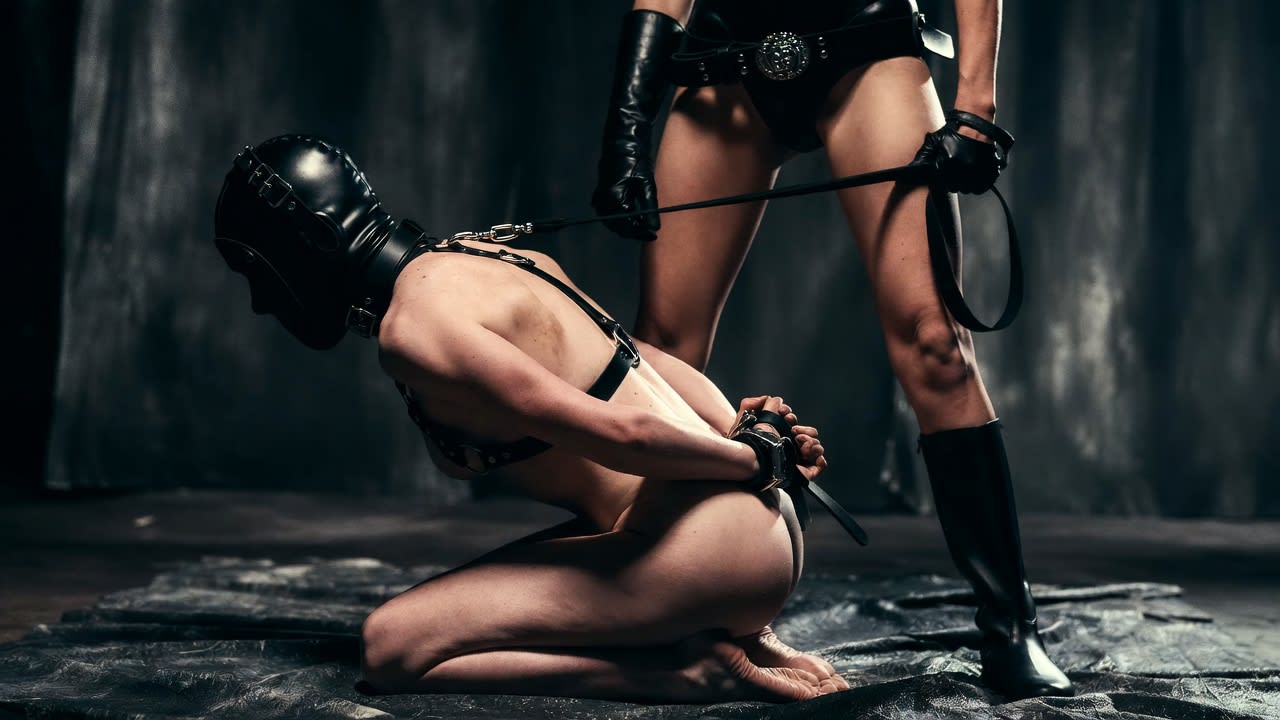
There is a version of the leash everyone imagines first: the walk. The lead loose between her hand and your collar, your steps matched to hers, the world moving past while you follow. It is a beautiful picture. It is also not the whole story.
Because sometimes the leash does not ask you to move at all. Sometimes it draws you down instead — down onto your knees, down past kneeling into something deeper, folded forward over your own thighs until your shoulders round and your head hangs low in the dark of the hood. Wrists cuffed behind your back. The line running up from your collar to her gloved hand, taut as a held breath. Her boots planted on either side of your world.
This is the deep kneel. It is the leash at its most honest. And if you have never been taken there, let me walk you down.
The Geometry of Above and Below
Power exchange is often described in words. Contracts, rules, titles. But before any of that, it is a shape. Two bodies arranging themselves into a single sentence.
In this shape, the sentence is simple. She stands. You fold. She is vertical — boots, bare thighs, the belt at her hips, the glove closed around the lead. You are horizontal, or as close to it as a kneeling body can come. The distance between her hand and your collar is the entire dynamic, drawn in one dark line.
Notice what the taut leash does that a slack one cannot. A slack leash says: I trust you to stay. A taut leash says something else. It says: I have you. Right now. Not as an idea, not as an agreement on paper, but as a physical fact you can feel at your throat every time either of you breathes.
Neither is better. They are different rooms in the same house. But the taut line, drawn down — that one lives further in.
What the Hood Takes First
Add the hood, and the shape closes around you.
Inside the leather there is no room, no floor, no her. There is warmth, the smell of hide, the sound of your own breathing made close and loud. Your sight is gone. Your face — the tool you have used your whole life to negotiate, to charm, to apologize, to perform — is gone with it.
What remains is astonishingly precise. The bite of the cuffs at your wrists. The pull of the harness across your ribs. The cold of the floor through your knees. And above all, the leash: the one thread still connecting you to another human being. Every small shift of her hand travels down that line and arrives at your collar like a message. You learn to read it the way the blind read fingertips.
People who have never worn a hood assume it must feel like being erased. Those who wear one know better. Nothing about you is erased. You are simply, finally, reduced to what is true: a body, a breath, a willingness. Everything performative burns off. What is left kneels.
Wrists Behind: Where the Argument Ends
The cuffs matter more than they appear to.
Hands are how we keep our options open. Hands break falls, open doors, push away. As long as your hands are free, some part of your mind stays on duty — quietly, beneath everything, holding the exits.
Cuff the wrists behind the back and that duty officer finally goes off shift. You cannot catch yourself now. If you fold forward, you fold because she allows the line to lower you, inch by inch, her hand paying out the leash like a rope over a cliff edge. Your balance belongs to her. Your uprightness belongs to her. The floor is close and dark and patient, and whether you meet it is no longer your decision.
This is the point at which many submissives report something unexpected: not fear, but relief. The argument you have been having with yourself all week — hold it together, stay in control, manage everything — ends. There is nothing left to manage. She has it. All of it. You can hear it in the creak of her glove on the leather lead.
The Taut Line Is a Conversation
From the outside, this scene looks like stillness. From the inside, it is one of the most talkative moments in power exchange.
What travels down the leash
Her weight shifts, and you feel it. She gathers an inch of slack, and your spine answers before your mind has caught up. She holds the line steady for a long minute — and that steadiness is a sentence too: I am not going anywhere. Neither are you.
A skilled dominant plays a taut leash the way a musician holds a long note. Not pulling for the sake of pulling. Listening through it. She can feel your breathing at her end of the line. She can feel the moment your shoulders finally drop, the small surrender inside the larger one, the instant you stop bracing and start belonging.
What travels back up
And you — hooded, wordless, hands gone — are not silent either. Your stillness speaks. The slow lengthening of your breath speaks. The way you lean a fraction of a degree into the pull rather than away from it: that is the clearest thing you will say all night. No safeword needed, no plea, no performance. Just a body telling the truth upward through a strip of leather.
Built Long Before the Clip Closes
Now, the unglamorous part — which is, as always, the part that makes the glamour possible.
Nobody should be hooded, cuffed, and drawn down on a taut lead by someone they have not built real trust with. This scene removes sight, speech, hands, and balance all at once. That is a great deal of surrender stacked on a single point, and it must rest on a foundation laid earlier, in full light, with clear words.
The conversation comes first. Limits, signals, what the hood does and does not cover, how you will speak when your mouth cannot — a dropped object held in the hand, a hum pattern, a tap of the fingers against the cuffs. Breath and circulation are checked, then checked again. The floor beneath the knees is considered: padding is not a compromise of the aesthetic, it is what allows the aesthetic to last longer than ten minutes.
None of this diminishes the scene. It is the scene. Her competence is the ground you kneel on. The reason you can fall so far inward at the end of her leash is that you know — not hope, know — that the woman holding it has thought about everything you are no longer able to think about.
For the One Standing
A word for her, boots planted, lead in hand.
What you hold is not a restraint. It is a heartbeat on a line. The creature folded at your feet has handed you their sight, their voice, their hands, and their balance, and is trusting you to hold all four while they go somewhere deep and wordless. Stand accordingly.
Take your time. The temptation, early on, is to do something — to direct, to escalate, to fill the silence. Resist it. The deep kneel does not need your activity; it needs your presence. Let them feel, through the line, that you are unhurried. That you have planted yourself above them like something built to last. The most devastating thing you can transmit down a taut leash is calm.
And watch. The hood hides the face but the body hides nothing: the breathing, the small tremors, the melt when it comes. You will know when they arrive at the bottom. It looks like nothing happening. It feels, at your end of the lead, like everything settling into your hand at once.
Rising Again
No one stays at the bottom. That is not the design.
When she brings you up, she brings you up slowly — slack returning to the line, her hands at your shoulders, the hood loosened so the light arrives in stages instead of all at once. Your wrists are freed and rubbed warm. You will likely be quiet for a while. The words come back in their own time, and a good dominant does not rush them.
What you carry away from the deep kneel is not a bruise or a story. It is a residue of stillness. For a few hours, or a few days, the noise in you sits lower. You have been all the way down — held there, kept there, and brought back — and something in your nervous system now knows the way.
That knowledge is the real gift of the taut leash. Not the pull itself, but the proof it leaves behind: that you can let go of everything you use to hold yourself upright, and be held anyway.
Kneel deeply. Choose the hand that holds the line with care. And when she draws you down — go.
— Mistress Krigar