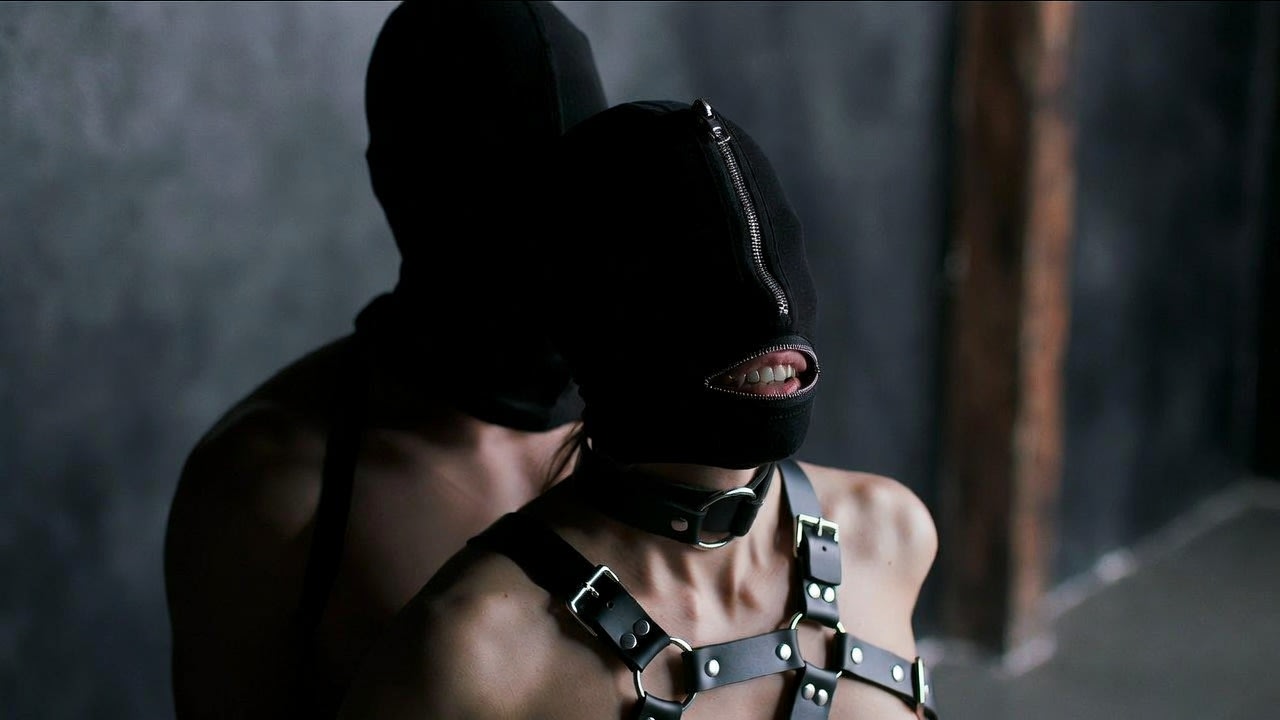
There is a particular hush that arrives when the hood goes on. Not silence, exactly — you can still hear your own breath, louder now, closer than it has ever been. But the world narrows. The room folds down to the inside of black fabric, and the mouth, the one opening left to you, waits behind a small metal zip.
This is where surrender turns quiet. Not theatrical. Not loud. Just a slow settling into being unseen.
The face is the first thing we hide behind
Consider how much work a face does. It performs. It manages. It arranges itself into whatever expression it thinks is wanted, and it does this so constantly that most people never feel the effort. We wear our faces like armour we forgot we put on.
A sensory deprivation hood takes that armour away in a single, decisive motion. The moment the leather or fabric closes over you, there is nothing left to perform with. No reassuring smile to offer. No flicker of the eyes to negotiate the moment. You are handed back to yourself, stripped of the small social machinery you rely on — and, strangely, that is where the relief begins.
Because if no one can read your face, you no longer have to author it. You get to stop. And stopping, for a certain kind of person, is the most difficult and most longed-for thing in the world.
The zip is a decision, not a cruelty
Look closely at the hood in the image above. It is not sealed shut. There is a zip across the mouth, and the zip is open — teeth showing, breath moving freely, the one part of the face left uncovered and undefended.
That detail is the whole philosophy. A hood does not have to erase you completely to work. The art is in what is closed and what is left open. Sight goes. Recognition goes. But the mouth remains — able to breathe, able to speak, able to say the word that ends everything in an instant.
A zip is a choice made visible. It says: I decide when your voice is yours and when it rests. And a choice, made openly and agreed upon in advance, is the opposite of cruelty. It is care with a firm hand.
Voice as the last boundary
People who have never played this way assume the frightening part is losing sight. It rarely is. What tests a submissive most is the question of the voice — whether they will be allowed to fill the silence with chatter, with nervous narration, with the running commentary the mind uses to stay in control.
The hood answers that question. Under it, speech becomes precious. You stop spending words. You save them for what matters: a colour, a number, a single honest sound. And when you do speak, it lands, because you have not wasted a syllable on managing the room.
This is why the exposed mouth matters more than the covered eyes. Blindness is atmosphere. The mouth is the boundary. The mouth is where trust lives.
Anonymity is a strange kind of freedom
There is a myth that submission is about being watched — displayed, exposed, seen in your most vulnerable state. Sometimes it is. But the hood offers the mirror image of that, and it is just as powerful: the freedom of not being seen at all.
When your face disappears, so does your name, your day, the person who answered emails an hour ago. What is left is only the body and the breath and the low hum of anticipation. You become anonymous even to yourself. And in that anonymity, desires you keep carefully folded away can finally unfold, because there is no witness to remember them, no expression to give them away.
Many submissives describe this as the moment they stop performing pleasure and start feeling it. The hood does not take something from them. It gives them permission to be undignified, greedy, quiet, still — whatever the moment asks — without an audience to please.
What the one who holds the hood carries
Power in this exchange is not loud. Notice, in the picture, the second presence — near, patient, unhurried. The one who places the hood does not gain control by force. They are handed it. And what is handed to you must be carried well.
To hood someone is to become their eyes. You watch the rise and fall of their ribs. You keep a hand where they can find it. You read the body that can no longer read the room, and you stay a half-step ahead of it. The dominant in a scene like this is not the one doing the least work. They are doing all of it, quietly, so their partner can do none.
That is the deilig paradox of power exchange: the more someone surrenders, the more attentive their keeper must become. Control and care are the same gesture, held from two ends.
Trust is the thread that never gets sealed
Everything here rests on one agreement made before the hood ever appears. The colour that means slow down. The word that means stop. The signal for the moment speech is gone entirely. These are settled in the light, calmly, like adults deciding how to hold something fragile.
Negotiation is not the unsexy part that comes before the good part. It is the reason the good part is possible. The zip can close because the safeword cannot. One opening is always kept, always honoured, always faster than any fantasy. That is the thread that never gets sealed shut — and knowing it is there is precisely what lets a person let go of everything else.
Aftercare closes the circle. When the hood comes off, the light is too bright and the face feels new, blinking, a little unguarded. That is the tender part. Water, warmth, a quiet word, skin against skin while the world comes back into focus. You do not leave someone alone at the door they just walked through.
Coming back into the light
The hood is not about disappearing. It is about choosing, for a while, to be held so completely that you can set down the exhausting work of being visible. And then it is about coming back — slower, softer, more yourself than when you went under.
Behind the zip there is no shame. Only breath, and trust, and the particular peace of being unseen by everyone except the one person you asked to watch.
That is the surrender we mean. Quiet. Deliberate. Deeply, unmistakably yours.
— Mistress Krigar