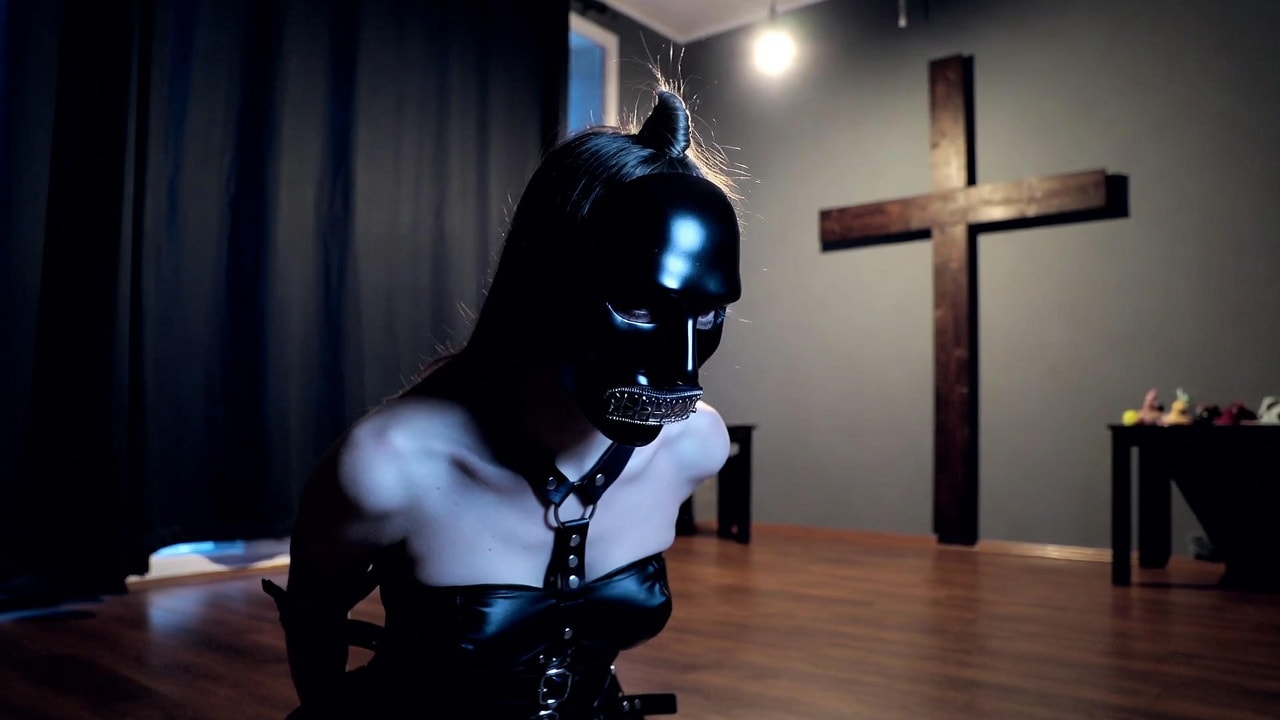
The room is quiet in the way only intentional rooms are quiet. Dark curtains pulled against the evening. One lamp, low. A wooden cross on the wall — patient, unhurried furniture that has seen more honesty than most confessionals. And in the middle of the floor, on her knees, a figure in black leather whose face you cannot see.
Her hair is drawn through the crown of the mask like a plume. Her shoulders are bare. The straps of the harness lie against her collarbone the way a hand might. She is not performing for anyone. She is simply waiting — and the mask is why she can.
People who have never worn one assume the mask is about concealment. Something to hide behind. They have it exactly backwards. The mask is not where a submissive hides. The mask is where she finally stops hiding.
What a Mask Takes Away
Consider what your face does all day. It negotiates. It reassures. It apologizes before you have said a word. It performs competence in meetings and warmth at dinners and patience in queues. The face is a full-time employee, and it never, ever clocks out.
Now buckle leather over it.
The first thing the mask takes is the audience. Not the Dominant — she remains, more present than ever — but the imagined audience every one of us carries: the watchers, the judges, the mirror. With the face covered, there is no expression to manage. No flicker of self-consciousness to suppress. Nobody is reading you, so you can stop writing.
The face is a performance. The mask ends the show.
This is why so many submissives describe the moment the mask settles as a long exhale. The performance ends. What is left underneath is not emptiness — it is the person who was always there beneath the performance, the one who rarely gets to exist in daylight. Quieter. Simpler. Startlingly honest.
What a Mask Gives Back
Anonymity is usually discussed as a loss — of identity, of individuality, of name. In the playroom it works in reverse. Take away the name, and what remains is the role. Take away the face, and what remains is the body's language: the set of the shoulders, the depth of the breath, the willingness in a straight spine and folded knees.
The submissive in the mask is not less herself. She is distilled. Everything social has been poured off, and what is left in the glass is concentrated: her obedience, her attention, her desire to be exactly where she is. A masked submissive kneeling in a quiet room is one of the most legible sights in the world. You know precisely what she is saying, because she has been relieved of every other thing to say.
There is also a gift in it that few talk about: permission. Behind leather, a shy person can be shameless. A person who blushes can burn without being seen to burn. The mask holds the face so the rest of her can let go. For many, the boldest things they have ever offered were offered faceless — not because they were ashamed, but because facelessness made the offering pure. No expression to soften it. No smile to make it polite. Just the act, and the meaning of the act.
Anonymity Is Not Hiding
Let me be precise about this, because the distinction matters.
Hiding is what we do when we are afraid of being known. Anonymity, chosen and negotiated inside power exchange, is the opposite: it is the decision to be known by essence rather than by surface. The Dominant who looks at a masked submissive is not seeing less of her. She is seeing what the face usually obscures — the posture of the will itself.
This is why the mask belongs to trust, not to distance. You do not give up your face to someone you doubt. Sight is a defense; expression is a negotiation tool; being recognizable is a kind of leverage. To kneel faceless before someone is to set down all three. It says: I do not need to watch your reaction to feel safe. I do not need my expressions to plead my case. You may have the whole of me without the part I usually bargain with.
Very few gestures say so much, so quietly.
The Ritual of Putting It On
A mask should never be thrown on the way you pull on a jumper. It deserves ceremony, because ceremony is what separates gear from meaning.
Slowly. Deliberately. Every buckle a sentence.
In my rooms the ritual is unhurried. The submissive kneels first — the mask comes to her, not the other way around. Hair is gathered and drawn through. The leather is warmed in the hands before it touches skin, because cold leather is careless leather. Then the buckles, one at a time, each one a small closing of a door between her and the world outside this room. By the last strap she is somewhere else entirely — not gone, but arrived. Present in a way the bare-faced rarely manage.
And here is the discipline of it: once the mask is on, there is nothing to do. That is the point. The masked submissive kneels, and waits, and the waiting is the practice. No phone, no mirror, no face to arrange. Just breath moving through leather, the creak of a strap when she settles, the knowledge that she will be attended to when it pleases someone else — and not one minute before. If you have never waited like that, I can tell you it does something to time. It thickens it. Makes it deilig — indulgent, unhurried, worth being inside of.
Trust Wears Leather
None of this works without the frame around it, so let the frame be said plainly.
The mask is negotiated before it is buckled. Limits are spoken with the face still bare — what is welcome, what is not, how she signals if words are hard to reach. Breathing is never compromised. Signals are agreed: a gesture, a sound, an object dropped from the hand. Check-ins happen, unglamorous and non-negotiable, because the deepest scenes are built on the dullest safety habits. Anonymity within a scene is a chosen garment, worn over consent — never instead of it.
This, too, is part of why the mask deepens surrender rather than cheapening it. She can let the world go precisely because she knows the person holding the room has not let her go for a single second. The Dominant watches more carefully when the face is covered, not less. Reads the breath. Reads the hands. The mask transfers the work of vigilance from her to me. That transfer is the entire architecture of power exchange, rendered in leather and steel.
When the Mask Comes Off
The unbuckling matters as much as the buckling. Slowly again. A hand at the back of the neck. Light kept low, because eyes that have been in the dark deserve courtesy. And then the face returns — soft, unarranged, blinking, more honest than it was when the evening began.
That is the quiet secret of the mask: it gives the face back improved. People who spend an hour without their performance often find they need less of it afterwards. They have knelt as no one, and been valued completely, and something in that arithmetic rearranges a person.
So if the masked figure in the low-lit room unsettles you, look again. Nothing about her is absent. She is the most present person in the house. She has set down her name, her face, and her audience, and kept only what she came to give.
Surrender rarely looks like much from the outside. A mask. A kneel. A room holding its breath.
From the inside, it is everything.
— Mistress Krigar