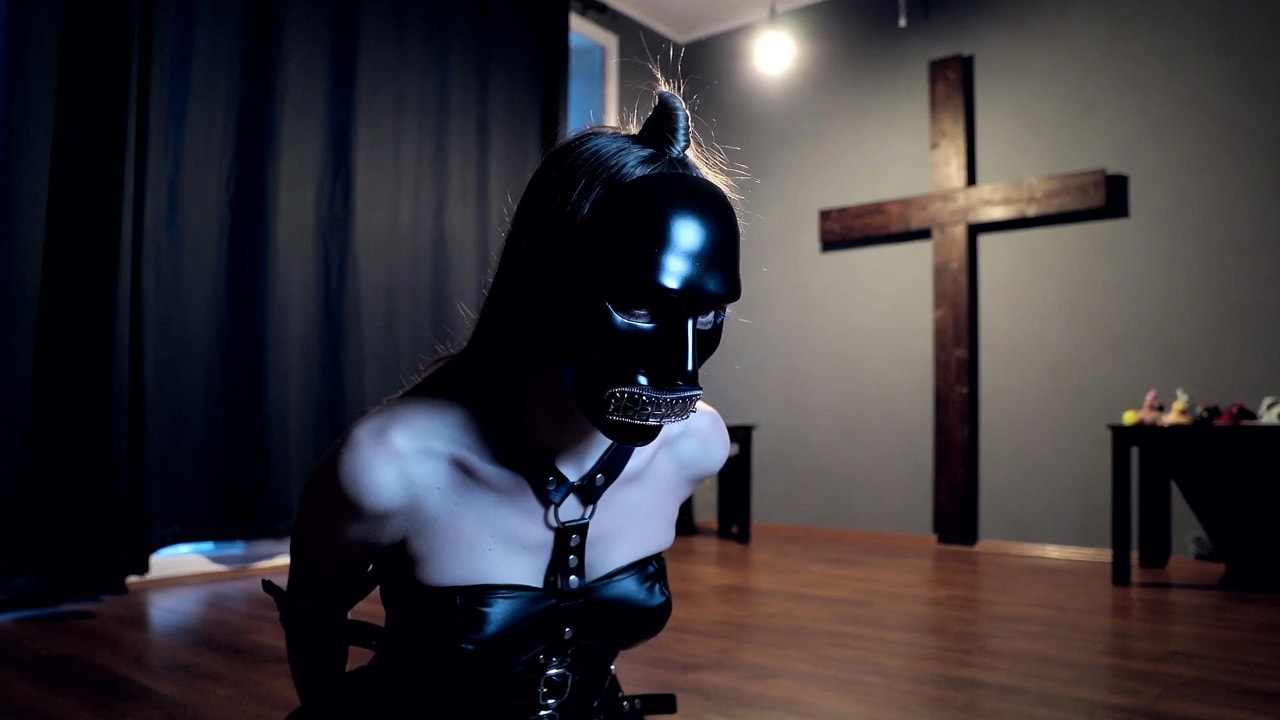
There is a particular silence that arrives the moment the mask goes on. Not the absence of sound — the room still breathes, the floor still creaks, the single warm light still hums against the dark. A different silence. The quieting of the self. The face you carry through the ordinary world disappears, and with it, for a little while, everything you have to be when people can see you.
This is where surrender begins. Not with rope. Not with a command. With the simple, deliberate act of letting yourself become unrecognisable, and trusting someone enough to meet you there.
The Face We Perform
You wear a face all day. You wear it at work, at the dinner table, in the small talk and the long meetings. It smiles when smiling is expected. It composes itself. It manages. By the time the day is done, that face is tired in a way that has nothing to do with muscles.
The mask does something most people never let themselves experience: it takes the performance away. When your features are hidden, there is no expression to manage, no eyes to read yours, no one waiting to interpret the smallest flicker of you. You are released from the work of being legible.
People assume the mask is about hiding. It is not. It is about being relieved of the obligation to be seen. There is a deep, almost embarrassing comfort in that — and comfort is exactly the right word, even here, in the dark, on your knees.
Anonymity Is Not Disappearance
Let me be precise, because this matters. To put on a mask is not to vanish. It is to become more fully present in the only thing that remains.
Strip away the face and you are left with breath. With the rise and fall of the chest. With the warmth of leather against the jaw, the small sounds you make and cannot disguise, the weight of your own body settling onto the floor. The mask narrows the world until all that is left is sensation and intention. Everything you usually use to hold yourself together — the eye contact, the carefully chosen expression — is simply gone.
And what is underneath, when the performance falls away? That is the question. For many submissives, the honest answer is: I don't know yet. Show me.
The paradox of losing yourself
Here is the paradox that the uninitiated never quite believe. You do not lose yourself behind the mask. You find the part of yourself that the daylight never lets you near.
The one who does not have to decide. The one who does not have to be competent, composed, in charge of everything. The one who can simply kneel, and breathe, and be moved through an experience by someone they trust. That self is real. It has been waiting. The mask is only the door.
Trust Is the Whole Architecture
None of this works without trust. This is the part the films and the fantasies leave out, and it is the part that matters most.
To be hooded — to surrender your sight, your face, your easy bearings — is to hand someone an enormous amount. You are saying: I will let you narrow my world. I will let myself be led when I cannot see the way. I will trust that the hands in the dark are kind, even when they are firm.
That trust is not given lightly and should never be taken lightly. The dominant who understands this knows that anonymity heightens everything. A touch lands harder when you cannot see it coming. A voice carries further when it is the only thing reaching you. Silence stretches longer. The responsibility, in that small dark world, belongs entirely to the one still holding the room.
The mask does not remove consent. It refines it. Boundaries spoken before the hood goes on are the walls that make the surrender safe.
What is settled before the dark
Everything that matters is agreed in the light. The limits. The signal that ends it. The shape of what is wanted and the firm edges of what is not. A safeword that works even when speech is muffled — a sound, a movement, a dropped object that means stop, instantly and without question.
Only when that scaffolding is in place does the mask become freedom rather than fear. Surrender is not the absence of control. It is control, handed over deliberately, by someone who could take it back at any moment and chooses not to.
The Room Holds the Ritual
Notice the space these moments are built in. The low light. The drawn curtains keeping the ordinary world out. The objects that mean something only to the people inside the room. None of it is accidental.
A play space is a sanctuary in the oldest sense — a place set apart, where the rules of outside do not reach. The threshold matters. Crossing it is part of the ritual. You leave the day at the door. You leave the performing face there too, folded up beside your shoes.
This is why so much of this lifestyle is, in truth, deeply intentional. Slow. Considered. The opposite of careless. There is nothing chaotic about real surrender. It is one of the most carefully constructed experiences two people can build together — a thing you sink into precisely because every edge of it has been thought through.
Why the Mask Frees Rather Than Confines
People who have never tried it imagine the hood as claustrophobic. A closing-in. And for some it will be too much, and that is information, not failure — the body knows what it can hold.
But for many, the opposite is true. The mask is where the shoulders finally drop. Where the jaw, clenched all day, finally lets go. The narrowing of the senses is not a cage; it is a clearing. Everything irrelevant falls away and what remains is startlingly simple: you, your breath, the trust between you and the one in the room, and the slow unspooling of a tension you did not know you were carrying.
There is a word for this kind of pleasure that has nothing to do with anything explicit. It is the pleasure of being fully, finally allowed to stop holding yourself up.
Surrender as restoration
This is the secret the mask keeps. Submission, done with care, is not depletion. It is restoration. To be led, held, and directed for an hour — to set down the relentless weight of choosing — is one of the few genuine rests a busy, capable person ever gets.
You come back to your own face afterward changed. Lighter. The world you walked away from is still there, waiting at the door with your shoes. But you meet it differently, because for a little while you were allowed to be no one, and in being no one, you remembered something true about who you are.
If You Are Drawn to This
Begin slowly. Begin with conversation, not equipment. The hood is the last step, not the first. Talk about what draws you to anonymity — is it the relief of being unseen, the intensity of heightened sensation, the trust it demands, or simply curiosity that will not leave you alone?
Start with something light. A soft blindfold before a full hood. A few minutes before an hour. Build the trust the way you build anything that is meant to last — in layers, with patience, paying attention to what your body tells you each step of the way.
And keep the architecture intact. Limits first. A signal that always works. Care afterward, when the mask comes off and the world rushes back in and you need a moment, and warmth, and someone to hold the quiet with you while you return.
The mask is not an escape from yourself. It is, for those who are ready, the most direct route back to a self the daylight never lets you reach. Soft. Deliberate. Yours.
SubSurrender is an adults-only space. Everything here rests on consent, clear boundaries, and care. Explore at your own pace — there is no rush in the dark.