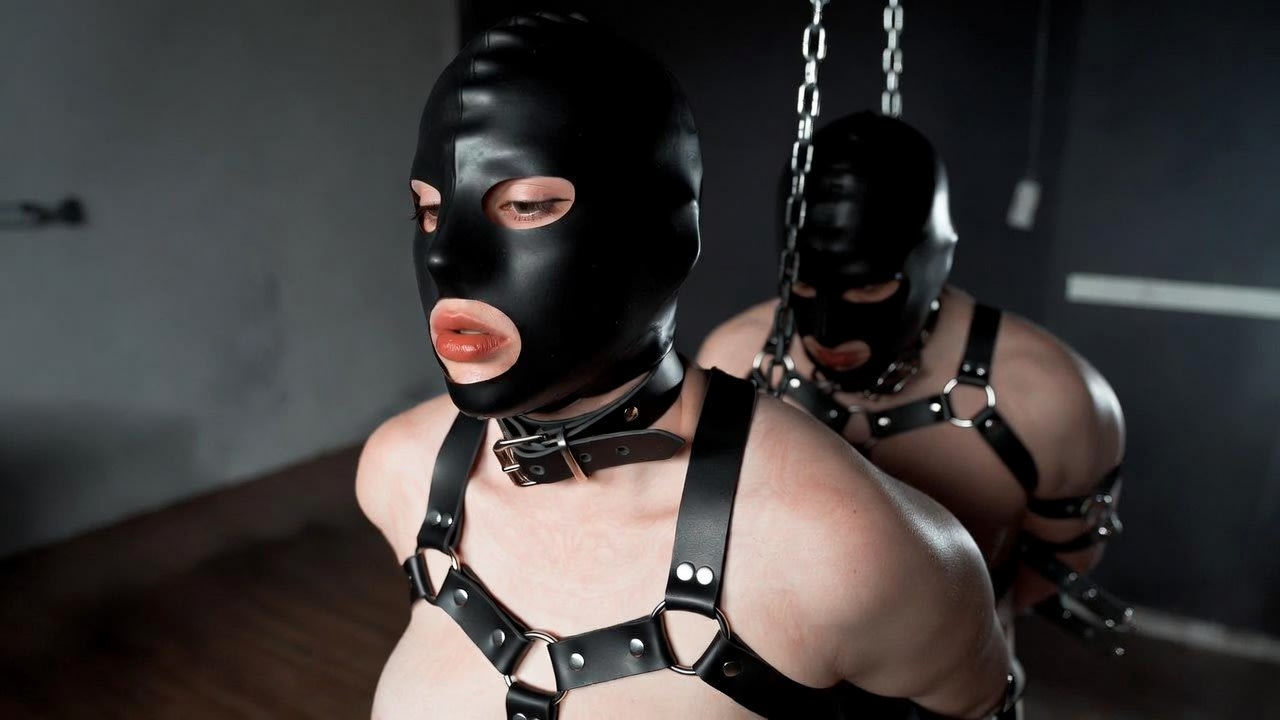
There is a particular quiet that arrives the moment the hood goes on. The world narrows. Sound softens at the edges. Your own breath becomes the loudest thing in the room. And in that close, leather-scented dark, something you have been carrying all day — the name, the face, the role you perform for everyone else — finally sets itself down.
This is not about hiding. It is about being released.
The face is a costume too
We forget that the face is the hardest-working part of us. It manages. It reassures. It performs competence in meetings, patience in queues, ease at dinners we would rather skip. By the end of an ordinary day, the face has told a hundred small lies on our behalf, and we are exhausted in a way that sleep does not quite fix.
The leather hood does something almost rude in its simplicity: it takes the costume away. Eyes still open to the world through two clean cuts. The mouth still breathes, still speaks, still says yes and says the word that stops everything. But the performance is gone. There is no expression left to manage, nothing to arrange for an audience. What remains is only sensation, only obedience, only the slow, deliberate exchange happening between two people who have agreed on exactly what is about to occur.
Anonymity, in the right hands, is not erasure. It is permission.
What you lose when you cannot be seen
Consider the two figures in the dark. Hooded. Collared. Held in their harnesses of leather and steel, the chains overhead doing their patient work. From the outside it can look like a loss — of identity, of control, of self. People who have never felt it assume the hood is a kind of disappearance.
It is the opposite.
When the face is covered, the parts of you that usually hide behind it have nowhere left to go. The submissive who spends all week being capable, decisive, relied upon — that person can finally stop being the one who holds everything together. Under the hood there is no title. No inbox. No reputation to protect. There is only the body, the breath, and the voice of the one in command.
That is why so many find their deepest surrender not when they are exposed, but when they are concealed. The mask does not take you away from yourself. It takes away everyone you were pretending to be, and leaves the truer, simpler creature underneath: the one that wants to kneel, the one that wants to be told, the one that has been waiting all this time to be allowed.
The collar speaks where the face cannot
Look closer at the leather. A harness across the chest, fitted and intentional. A collar buckled at the throat, snug enough to be felt with every swallow. These are not decoration. They are language.
When the face is hidden, the body has to do the talking, and the gear is how it speaks. The collar says claimed. The harness says held. Each strap is a sentence in a conversation that needs no words — a continuous, quiet reminder pressed against the skin: you are mine for now, and you chose this.
There is enormous comfort in that pressure. The collar at the throat is not a threat; it is an anchor. It tells the nervous system, again and again, that the decisions have been handed over, that someone competent and caring is holding the reins, that the only job left is to feel and to follow. For a mind that never stops calculating, this is close to mercy.
Surrender is not weakness — it is trust under tension
Let us be honest about what is really happening here, because the world outside misreads it constantly.
To put on the hood is to make yourself deliberately vulnerable in the presence of another. You agree to see less, to anticipate less, to control less. That is not submission as defeat. That is submission as the most demanding kind of trust there is — trust offered while restrained, while concealed, while the chains take a little of your weight.
And trust like that is never given to just anyone. It is earned. The Dominant who deserves the hood is the one who has proven, slowly and repeatedly, that the dark is safe. That every limit named will be honoured. That the safeword is sacred. That attention will not waver while the submissive is at their most undefended. Power exchange is not the strong taking from the weak. It is two people building something taut and deliberate between them, and then trusting it to hold their weight.
The tension is the point. Pull a rope slack and nothing happens. Pull it taut between two people who trust the knots, and you can climb.
A note on the dark
People assume the hood is about sensory deprivation, and sometimes it is. But more often it is about sensory concentration. Take away the constant visual chatter — the room, the clutter, the hundred half-seen things the eye snags on — and everything that remains arrives louder.
The cool of the leather warming to your skin. The exact weight of a hand at the back of the neck. The change in a voice when it drops half a register and tells you to be still. A breath against the ear. The slow, grounding rhythm of being told what comes next. None of it is rushed. None of it is loud. It is simply more, because there is so much less competing for your attention.
This is why surrender done well feels less like an act and more like an immersion. You do not perform it. You sink into it. Deilig, as some would say — indulgent, intentional, the kind of experience you let yourself fall all the way into because someone you trust has promised to catch you.
How to begin, if the hood is calling you
If something in this stirs you, start where everything real starts: with a conversation, fully faced and fully named, before any leather comes near you.
Talk first
Decide together what the hood means for the two of you — how much sight stays, how breath is kept easy and clear, what a tap or a word will mean when speech is hard. Agree your limits out loud, in daylight, sober and unhurried. The negotiation is not a buzzkill. It is the foundation that lets the surrender go deep, because nothing frees the mind like knowing the edges are already drawn.
Go slowly
The first time the hood goes on, it may feel like a lot. That is normal. Let it be brief. Let the one in command keep checking, keep speaking, keep a hand on you so the dark always has a tether. Surrender is not a race. The depth comes with repetition, with proof piled on proof that the dark is safe.
Come back gently
Afterward — this matters as much as anything — come back to each other gently. Off comes the hood, on comes the light, and the two people who built the tension now ease it down together. Water. Warmth. A quiet word. The face returns, and it is met with care. That return is not an afterthought. It is the other half of the whole thing.
The truest face is the one no one sees
There is a paradox at the centre of all this, and it is worth sitting with.
We spend our lives believing the face is where the self lives — that to be seen is to be known. But ask anyone who has knelt in the dark behind the leather, anonymous and collared and entirely held, and they will tell you something stranger and more honest. Sometimes you are never more yourself than when no one can see your face at all.
The hood does not take you away. It brings you home.
So if you have felt the pull of it — the quiet, the concealment, the deep relief of handing it all over to someone who has earned the right to hold it — know that the desire is not strange and it is not shameful. It is one of the oldest, cleanest forms of trust there is.
Come in. Take off the costume. The dark has been waiting for you.
— Mistress Krigar