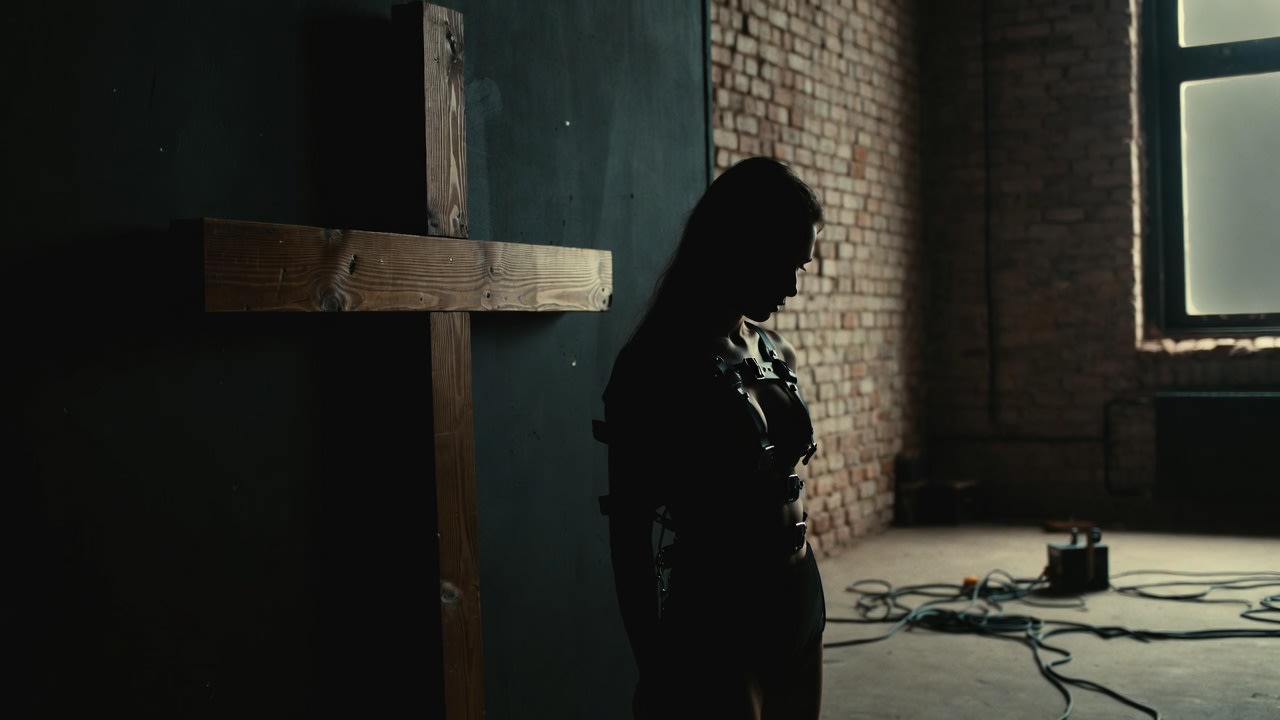
At the Cross: The Stillness Before Surrender
There is a moment before anything happens. Before a single strap is tightened. Before a hand is laid on you. You are standing in a quiet room, and the room is waiting too.
This is the part most people overlook. They imagine surrender as the act — the binding, the command, the touch. But surrender does not begin there. It begins in the stillness. It begins in the wait. And if you learn to stand inside that stillness without flinching, everything that follows becomes deeper, slower, and far more yours.
The Room Knows Before You Do
Picture the space. Bare brick, cold and honest. A tall window letting in a thin, grey light. Cables coiled on the concrete like something half-asleep. And there, against the dark, a cross of plain timber — heavy, patient, built to hold weight.
You are dressed in leather that follows the line of your body. Your head is lowered. Not in defeat. In attention. There is a difference, and you feel it the moment you stop resisting it.
The room is not romantic. It is not soft. It is intentional. Everything in it has a purpose, and for the length of this hour, so do you. That is the first gift of a deliberate space: it strips away the noise until only the essential remains. You. Your breath. The cross. The wait.
Why Bareness Matters
We fill our lives with cushioning. Distraction, apology, the constant low hum of being needed elsewhere. A bare room refuses all of that. It gives you nothing to hide behind, and in doing so, it gives you back to yourself.
When there is nothing to look at, you finally look inward. When there is nothing to do, you finally feel. The discomfort of that emptiness is not a flaw in the experience. It is the doorway.
Anticipation Is Not Waiting — It Is Surrender in Slow Motion
People talk about anticipation as if it were impatience dressed up nicely. It is not. Impatience wants the moment to end. Anticipation wants the moment to last.
To stand before the cross and not yet be bound to it is to live in a held breath. Your skin grows aware of itself. The leather warms against you. You begin to notice your own pulse, the weight of your own hair, the small involuntary tilt of your head toward the light. This is your body learning to listen.
And here is the quiet truth of it: the longer the wait, the more completely you give yourself over. Every second you remain still is a second you choose this. Anticipation is not the absence of surrender. It is surrender stretched thin enough to see through.
The Power You Keep by Staying Still
It looks like nothing is happening. A figure, a bowed head, a room holding its breath. But inside that stillness, a great deal is being decided.
You are not passive here. You are not waiting to be acted upon like an object on a shelf. You are holding a position — and holding a position is work. It asks for focus, for trust, for the steady refusal to fidget your way out of the intensity. The submissive who can stand still in anticipation is not weak. She is composed. She is, in the oldest sense of the word, devoted.
Stillness is its own kind of strength. Power exchange does not mean one person has all the power. It means power moves — handed over deliberately, received with care, and given back transformed. The wait is where the handing-over happens, breath by breath.
The Cross as Promise, Not Threat
A cross of wood in a dim room can look severe to the uninitiated. But look again. It is not there to frighten you. It is there to hold you.
Consider what it offers. A structure stronger than your own resolve. A place to set down the exhausting work of holding yourself together. When you are bound to something that will not let you fall, you are finally free to stop bracing. That is the paradox at the heart of this lifestyle: restraint can be the most profound form of release.
The cross does not take anything from you that you have not already offered. It simply makes the offer visible. It turns an interior yes into a shape you can lean against.
Trust Is Built Before the First Knot
None of this works without trust, and trust is not summoned in the moment — it is built long before, in a hundred small honesties. In the conversation about limits. In the word you both agree will stop everything. In the eyes that check on you and the voice that answers when you speak.
By the time you are standing at the cross, the trust should already be in the room with you, as solid as the timber. The stillness is where you feel it settle. You are not gambling. You are resting on a foundation you laid together, on purpose, with open eyes.
This is what separates true power exchange from mere performance. The drama is optional. The trust is not.
What the Bowed Head Teaches
Lower your head and notice what changes. The world narrows. Your gaze drops from the room to the small, intimate territory of your own body. You stop performing for the space and begin attending to yourself.
The bowed head is often read as submission, and it is — but it is also concentration. It is the posture of someone gathering herself, drawing her scattered attention into a single point. Prayer looks like this. So does deep thought. So does desire when it stops chasing and starts waiting.
In that lowered gaze there is no shame. There is no smallness. There is a woman deciding, with her whole quiet body, to be present for what she has chosen. That decision is not given to her. She makes it. Again and again, for as long as the stillness lasts.
The Sensuality of Restraint Held Back
Everything about this scene is suggestive precisely because nothing has happened yet. The leather traces her without gripping. The cross waits without binding. The light touches without warming. Desire lives in that gap — in the almost, in the not-yet, in the breath drawn and not released.
We are taught to rush toward the climax of things. But the most indulgent pleasure is often the slow approach: the deliberate refusal to hurry, the willingness to let tension build until it becomes its own reward. To linger in anticipation is to discover that the wanting is not lesser than the having. Sometimes it is sweeter.
This is the deilig art of holding back — savouring the edge instead of leaping past it. It asks for patience, and it repays patience generously.
How to Stand in Your Own Stillness
If you take nothing else from this, take a practice. The next time you find yourself at a threshold — before a scene, before a surrender, before any moment that asks for your full presence — do not rush to fill it.
Let your shoulders drop. Let your gaze lower. Breathe slowly enough to hear it. Feel the weight of your own body and the patience of the space around you. Notice that nothing is required of you yet except to be here, fully, and to choose to stay.
That is the whole of it. Surrender is not a collapse. It is a decision made calmly, in the quiet, before anyone touches you. The stillness is not the prelude to the experience. It is the experience, distilled.
Before the First Touch
So stand there a moment longer. The cross is patient. The room is patient. Let yourself be held by the waiting before you are held by anything else.
Everything that comes after will be richer for it — slower, deeper, more completely chosen. Because the truest surrender does not begin when the binding starts. It begins now, in the stillness, in the bowed head, in the breath you are holding as you read this.
Stay there. That is all I ask.
— Mistress Krigar