All the Way Down: The Deep Bow, the Cold Floor, and the Freedom of Making Yourself Small
There is a moment, right before the forehead touches the floor, when everything in you argues to stop halfway. To bow a little. To keep some part of yourself upright and watching. Most people live their whole lives at that halfway point. They never find out what waits on the other side of it.
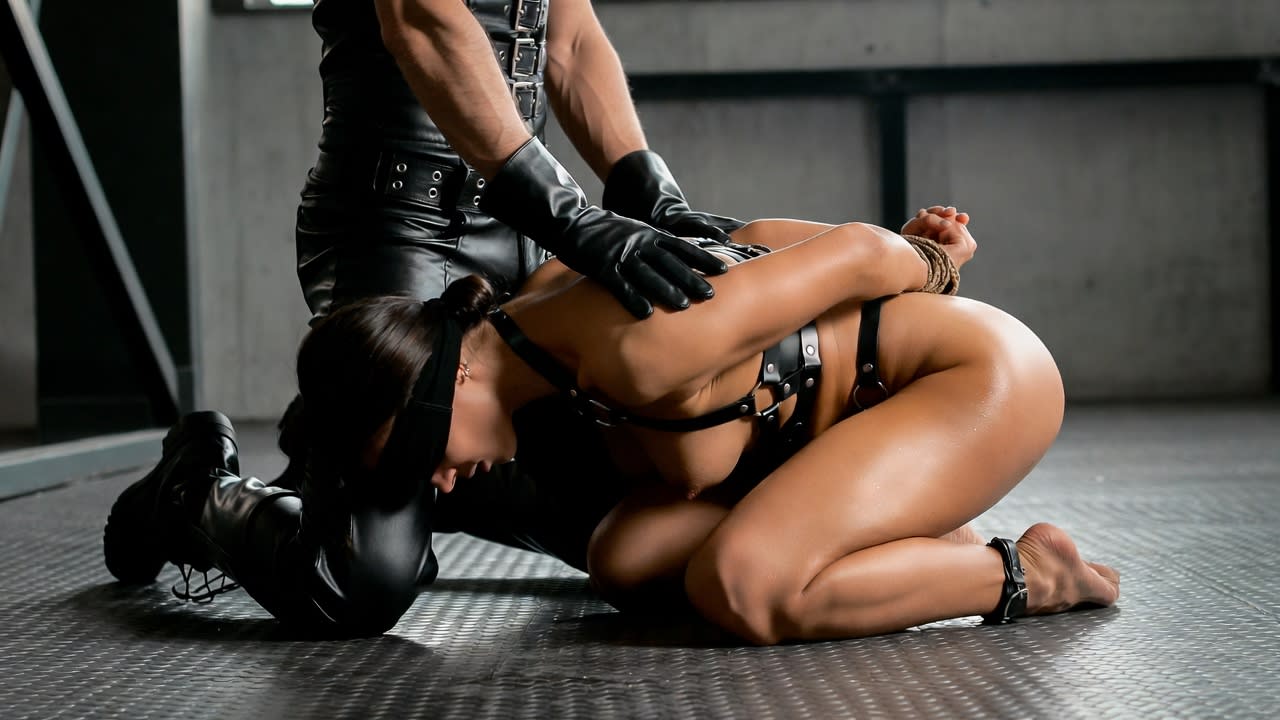
This is a piece about going all the way down. About the deepest bow there is — knees folded under you, spine curved, wrists bound, cheek near cold steel — and one warm hand resting on your back to keep you there. It looks, to the untrained eye, like defeat. It is the opposite. Let me show you why.
The Shape of the Deep Bow
Look at the body that has folded all the way down. It is not sprawled. It is not collapsed. It is gathered — knees tucked, weight settled, the long line of the back offered up like the curve of something being read. The head is lowered not because it was pushed, but because it was given.
Everything about the posture is intentional. That is what people miss. A deep bow is not the absence of strength; it is strength poured into a single, quiet shape. The muscles that hold you folded are working. The stillness that keeps you there is a discipline, not a surrender of will. You do not fall into this. You choose it, and then you hold it.
And the room around you is not soft. Concrete. Steel underfoot. Nothing in the space is designed to comfort you. That contrast is the point. When the floor is cold and hard and honest, the warmth left in your own body becomes something you can finally feel.
Why lower is not the same as less
We are taught, everywhere, that up is good and down is bad. Chin up. Rise. Stand tall. So the first time you take yourself all the way to the floor on purpose, something protests. A small voice insists you are losing.
You are not losing anything. You are setting it down. There is a difference between being made small and making yourself small, and the difference is everything. One is humiliation done to you. The other is a gift you place, deliberately, into hands you have decided to trust. The shape looks identical from across the room. Inside, they are worlds apart.
The Cold Floor
Skin against steel is a shock the first time. Then it is information. The floor does not flatter you. It does not hold you the way a bed holds you. It simply tells you, without sentiment, exactly where your body ends and the world begins.
That honesty is a kind of relief. So much of ordinary life is spent managing how we appear — softening edges, arranging ourselves, performing ease. The floor asks for none of that. It takes your weight and gives nothing back but the truth of contact. And in that plainness, the racing part of the mind finally has nothing left to do.
This is the quiet that most people never let themselves reach. Not the quiet of a soft evening. The deeper quiet underneath it — the one that only arrives when you have stopped holding yourself up.
The Hand on Your Back
Now the hand. A single palm, gloved in leather, laid flat between the shoulder blades. It is not pressing you down. You are already down. It is not restraining you. The rope has that job. So what is it doing?
It is keeping you company at the bottom.
That hand is the entire argument of power exchange, held in one gesture. It says: I know exactly where you are. I put you there, or I let you go there, and I have not looked away. You are not folded on a cold floor alone. You are folded on a cold floor witnessed. There is a weight on your spine that is not holding you prisoner — it is holding you present.
The difference between pushed and kept
A hand that pushes wants you to move. A hand that keeps wants you exactly as you are. The submissive who has learned the difference stops bracing for the next demand and simply rests inside the one that is already being made: stay.
Stay is one of the most generous commands a dominant can give. It asks for nothing but your continued surrender to the moment you are already in. No performance. No progress. No proving. Just the ongoing yes of a body that has agreed to be still and be kept.
What the Rope Says
The wrists are bound, drawn up and away, and this too is often misread. Rope is not there to stop you from leaving. Anyone who wants to leave a scene leaves it — that is what a safeword is for, and it is sacred. Rope is there to make a decision for you so your mind can stop making it over and over.
When your hands are bound, they are no longer yours to fret with. You cannot fix your hair, cover yourself, reach out, take back control in a hundred small nervous ways. The rope removes the option, and in removing it, removes the exhausting negotiation you would otherwise run in your own head. What is left is startling in its simplicity. You are held. You can rest.
Bondage, done with care, is not about capture. It is about permission. The knot says: you are allowed to stop trying now.
The Freedom Nobody Warns You About
Here is the thing they do not tell you when they whisper that submission is weakness. The deep bow is one of the freest places a person can be.
Think of everything you carry upright through an ordinary day. The decisions. The vigilance. The endless low hum of being responsible for yourself in every second. Now imagine setting all of it on the floor at once, on purpose, in front of someone who has agreed to carry it for a while. That is not a loss of self. That is a rest from the exhausting work of constantly defending one.
People come to surrender expecting to feel diminished. What they usually feel, once they have gone all the way down, is lighter. Emptied in the good way. The floor took their weight, the rope took their fidget, the hand took their loneliness, and what remained was a version of them that did not have to hold anything up at all.
Trust is the whole architecture
None of this works without trust, and trust is not a mood. It is built, slowly, out of kept promises. The dominant who earns a deep bow has earned it by being reliable in a hundred smaller moments first. The hand that rests on your spine has that privilege because it has never once used it carelessly.
Go down only as far as your trust has been built to hold you. A halfway bow with someone who has not earned more is not caution — it is wisdom. And a full bow with someone who has earned it is not recklessness. It is the most deliberate thing you will ever do.
How to Meet the Floor
If this calls to something in you, do not rush toward the deepest version of it. Surrender is not a competition, and depth is not a scoreboard. Begin where you are.
Kneel first. Learn the floor at that height. Notice what your mind does with the stillness before you ask your body for more. Let someone you trust rest a hand on your back and practice the single instruction — stay — until staying stops feeling like waiting and starts feeling like rest. The deep bow will be there when you are ready for it, and it will mean more for the patience.
And when you do finally go all the way down — forehead near the cold, spine offered, hands quiet in their rope, one steady palm keeping you company — you may notice something you did not expect. Not shame. Not smallness. Something closer to relief. The deilig, unhurried relief of a person who has, for once, put everything down and been allowed to leave it there.
That is the secret the upright world never tells you. Sometimes the strongest thing a body can do is fold, completely, and trust the hand that keeps it still.
— Mistress Krigar